Prioritizing Quality Before Synthesis in Paleoenvironmental Hazard Science
The field needs methodological and workforce development. A proposed new center should invest there first.
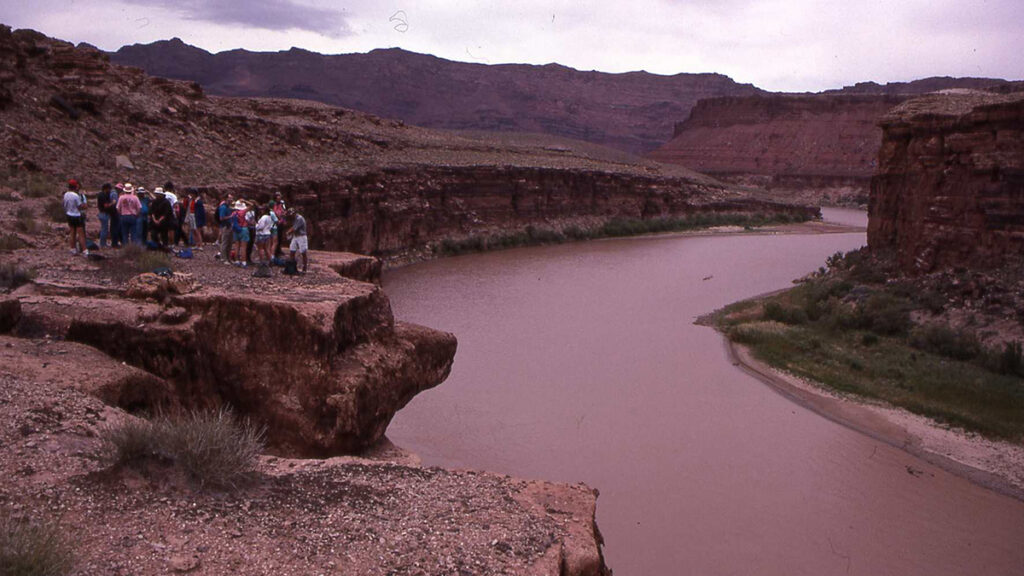
In May 1992, scientists met in Marble Canyon, Arizona, to discuss the First International Workshop on Paleoflood Hydrology. The canyon walls, formed by the Colorado River cutting into Permian sandstone, served as a natural archive of past flood events. Baker and his colleagues focused on slackwater deposits, fine-grained sediments left behind by floods in sheltered areas.
By employing hydraulic models and radiocarbon dating, they were able to determine past flood discharges and the timing of these events. Their findings revealed floods nearly twice as large as those recorded by modern instruments and occurring more frequently than previously estimated. These insights were invaluable to the U.S. Bureau of Reclamation, which incorporated the data into flood hazard assessments for dam safety and infrastructure design along the Colorado River.
Since then, the field of paleoflood hydrology has grown to encompass various settings and methodologies, such as studying boulder berms, alluvial fills, tree ring "flood rings," detrital layers in stalagmites, and historical archives. While the methods and precision vary among these approaches, each faces the challenge of translating qualitative or semiquantitative evidence into precise, uncertainty-bounded estimates usable by planners, engineers, and risk managers.
A new report from the National Academies of Sciences, Engineering, and Medicine proposes a center to integrate, synthesize, and translate paleoenvironmental data, recognizing that these records have not yet met the quality standards needed for effective translation.
Written by urgent.news from Eos's reporting — not their text. Machine-written — may contain errors; check the original before relying on it.