Not Quantum, Just Physics: What Extropic's Z1 Actually Means for AI
A quick explainer on Extropic's Z1 chip, its quantum-like features, its impact on AI, and why it's not quantum computing.
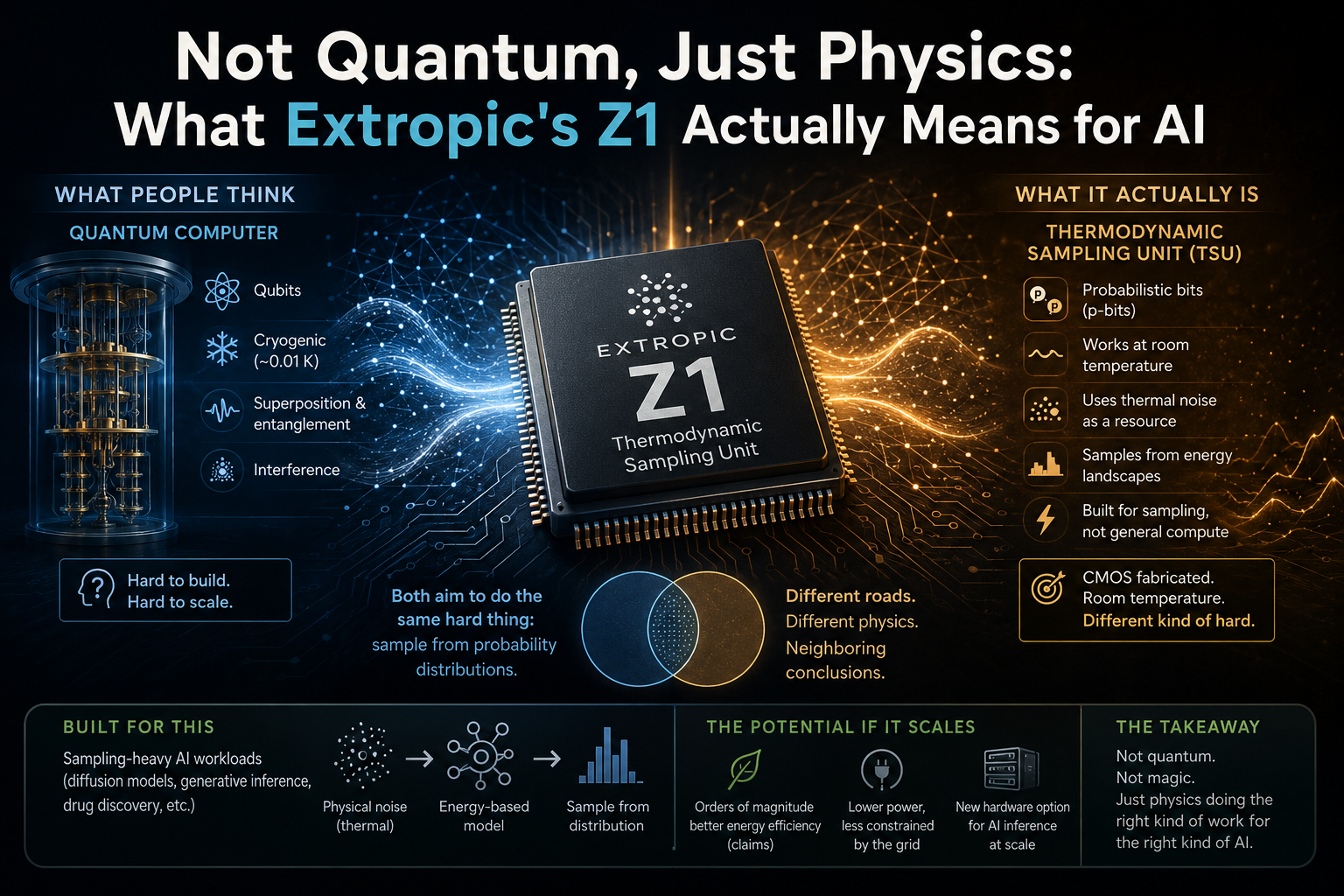
In a recent announcement, Extropic unveiled its Z1 chip, which has sparked discussions about its implications for artificial intelligence (AI). The chip is not a quantum computer, despite the initial confusion caused by its founder's extensive background in quantum computing. The Z1, also known as a thermodynamic sampling unit or TSU, operates differently from traditional digital chips. Instead of resisting thermal noise, it deliberately harnesses and shapes fluctuations caused by temperature changes.
Each Z1 contains hundreds of thousands of probabilistic bits, or p-bits, which are allowed to fluctuate under thermal noise. The chip's network of p-bit circuits settles into a state that represents a sample from a target probability distribution. This approach is similar to quantum computing's sampling capabilities but differs in that it operates at room temperature and uses standard CMOS fabrication processes.
The Z1 is designed to excel at sampling tasks, which are a significant component of modern AI. Generative models, such as diffusion models used for image generation or token sampling, currently rely on brute-force matrix multiplication on GPUs. This process is energy-intensive and indirect. The Z1, on the other hand, generates genuine physical randomness and shapes it directly into the desired sample, potentially offering substantial energy efficiency improvements.
However, the Z1 is not intended to replace GPUs or CPUs for general-purpose computing tasks. It is specifically optimized for sampling problems, which are central to many AI applications. While Extropic claims that their technology could achieve several orders of magnitude better energy efficiency than GPU-based sampling methods, it is crucial to recognize that the Z1 has specific applications and limitations.
Written by urgent.news from HackerNoon's reporting — not their text. Machine-written — may contain errors; check the original before relying on it.