India’s BrahMos at Sea: Implications for South Asian Stability
The planned Indian deployment of the BrahMos missile on all of its naval warships has destabilizing implications for the region.
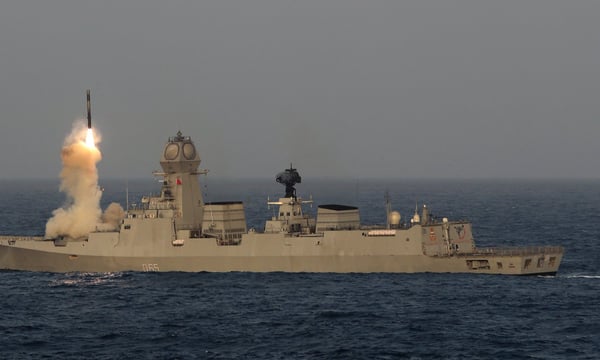
In May 2025, India and Pakistan engaged in naval confrontations limited to the air and land domains, but no active combat occurred. Both navies took a defensive posture, enhancing maritime ISR and readiness. Following a ceasefire, Indian Defense Minister Rajnath Singh warned Pakistan against any "nefarious" actions, threatening a potential naval response.
The Indian Navy plans to integrate BrahMos supersonic cruise missiles fleet-wide by 2030, reducing reliance on imported systems and increasing operational range, precision, and speed. India currently operates various missile types, including BrahMos, Klub, Kh-35E Uran, Exocet, and Harpoon. BrahMos, with Mach 3 speed and 800 km range, offers a significant advantage in targeting moving platforms.
Pakistan has developed its own anti-ship capabilities, including the P282 SMASH missile, Harbah subsonic cruise missile, YJ-83 anti-ship cruise missiles, and air-launched cruise missiles. Despite these efforts, India's comprehensive BrahMos integration poses a significant challenge to Pakistan's naval strategy and regional stability. The dual-capable nature of BrahMos, which can carry nuclear weapons, further escalates tensions in a nuclearized environment.
Written by urgent.news from The Diplomat's reporting — not their text. Machine-written — may contain errors; check the original before relying on it.