How I Learned to See Krasner and Pollock Together
Ahead of The Met’s joint exhibition of the artists, I set out to defend Lee Krasner. I ended up arguing against myself.
This year, the Metropolitan Museum of Art announced an upcoming exhibition titled Krasner and Pollock: Past Continuous, featuring a photograph of the artists by Hans Namuth. Naturally, I was disheartened and sought validation for my thoughts. While scrolling through the comments, I came across a familiar sentiment: "Give her a solo show!"
Prior to this, I had visited the Pollock-Krasner House in Springs, East Hampton, unaware of how much I didn't know about Lee Krasner. As a painter myself, I had visited the site in the aftermath of a failed relationship with another artist. I believed I already understood Krasner's story, thinking it was intertwined with my own.
The tour began in Krasner's studio, a small second-floor bedroom overlooking Accabonac Creek. The guide explained how Pollock would take over when it was too cold to paint in the barn, while Krasner would work by the warmth of the kitchen stove. In the living room, we learned about Krasner's navigation of gender bias, poverty, and Pollock's alcoholism, as she used her own credibility in the art world to promote his paintings, which supported their frugal life.
I couldn't help but mourn the countless paintings that may have been created had she not been burdened with Pollock's tumultuousness. After crossing the lawn to the barn where Pollock developed his drip technique, I found myself staring at the bare rectangles on the walls, fringed with splattered paint, the spaces where Krasner's canvases had hung.
Following Pollock's death, it took Krasner a year to claim the studio. Upon her return, she painted at a grand scale, filling the barn with her own explosive work. As the guide described Krasner's grief-induced insomnia, I struggled to reconcile her despair: Why, when she finally had the studio she deserved, was she so bereft? As I left the gift shop, I remembered the suggestion from an employee at the Pollock-Krasner House, Mary Gabriel, director of the Pollock-Krasner House.
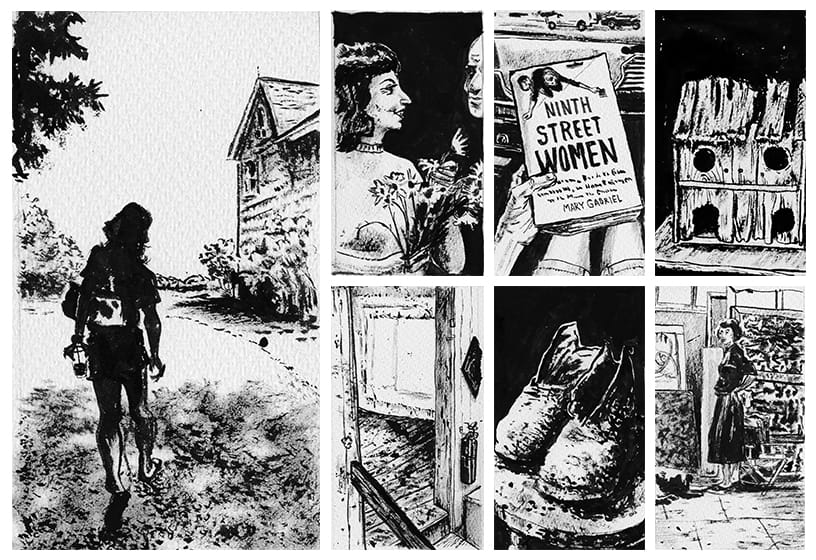
She gifted me Mary Gabriel's Ninth Street Women (2018), and we parted ways. As I stared at those bare rectangles, fringed with splattered paint, I couldn't help but think about Krasner's struggle and ambition. Later, I created a series of drawings from photographs of the house and finished Gabriel's book. I shared my work with Matt, the Pollock-Krasner House's director, via a video call.
Days before our conversation, The Met announced the exhibition. I initially expected Matt to share my disappointment over the decision to exhibit Krasner alongside Pollock. However, he was excited, stating that the artists led surprisingly domestic lives, sleeping in separate beds and making appointments to visit each other's studios.
He emphasized how their romance was rooted in their passion for art and the other's work. He rarely referred to the artists apart from each other, often using "they" and "them." When I attempted to highlight Krasner's sacrifices, he would return to their partnership. He even mentioned that perhaps Krasner had revisited her memories of Pollock, destroying and reassembling older paintings that no longer felt true to her evolving identity.
As I pondered this, I couldn't help but wonder if anyone intimately familiar with Krasner's life could conceive The Met's decision as anything other than appropriate. In my quest for answers, I reached out to Mary Gabriel via her publisher's website, sending my inquiry into the digital void. Four days later, she agreed to a Zoom call from her home in Ireland.
Written by urgent.news from Hyperallergic's reporting — not their text. Machine-written — may contain errors; check the original before relying on it.