Großer Zeh auf Abwegen: Hallux valgus: Was tun bei familiärer Vorbelastung?
Die Mutter hatte einen Hallux valgus, der operiert werden musste? Und weil die Genetik bei dieser Fußfehlstellung mitmischt, haben Sie Sorge, dass Ihnen das auch bevorsteht? Eine Expertin ordnet ein.
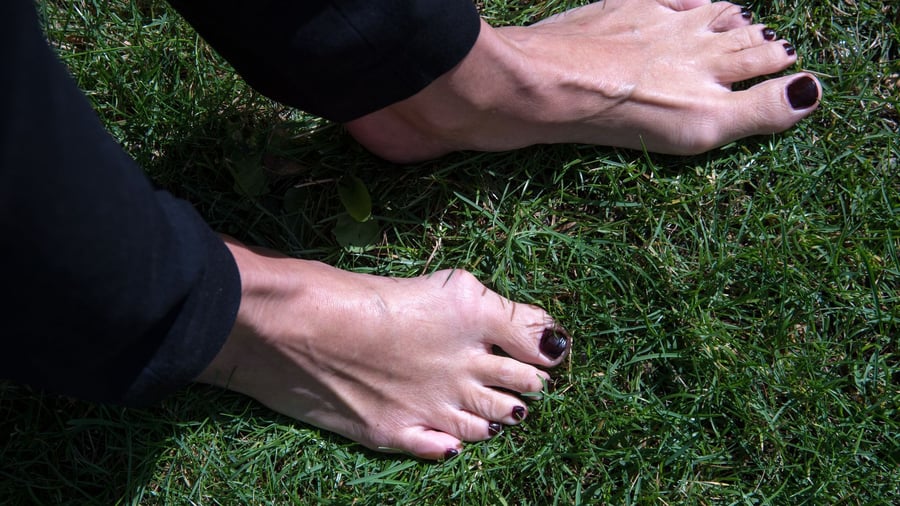
A prominent toe, also known as Hallux valgus, deviates more towards the outer edge of the foot, causing the ball of the foot on the inner side to protrude significantly. This is the appearance of a Hallux valgus, one of the most common foot deformities. It often runs in families. If either parent has a hallux valgus, the child is at a higher risk of inheriting the condition.
The surgeon Mellany Galla from Hannover explains that the Hallux valgus is not inherited, but a predisposition that can be caused by factors such as connective tissue weaknesses, increased joint mobility, or a certain foot shape like a flat foot. However, this does not necessarily mean that children of affected parents will develop Hallux valgus.
According to Galla, the condition can actually be prevented to some extent. The key to preventing the toes from straying into the outer edge of the foot is to wear well-fitting, flat shoes that provide enough space for the front part of the foot, reducing pressure on the toes and the ball of the foot. Galla also recommends regularly going barefoot on different surfaces such as sand or grass, as this strengthens the fine muscles in the feet, thus reducing the risk of Hallux valgus.
For those with foot deformities like a flat foot, well-fitted insoles are advisable and can help prevent the development of Hallux valgus, even though they cannot prevent the condition altogether. Galla advises incorporating regular strengthening foot exercises into daily life for those with a family history of the condition. In her book "The simplest foot exercises of all time" (Trias Verlag), Galla and physiotherapist Arndt Fengler reveal how to train the big toe extensor, an important muscle on the inner side of the foot arch.
Regularly performing this exercise helps straighten the big toe and prevent Hallux valgus. Galla explains that this exercise also helps develop a better sense of the fine movements of the feet and correct the longitudinal arch. It can be done sitting or standing, with the feet touching each other and the distance between the big toe bases being approximately the width of a thumb.
The exercise should be repeated 15-25 times, followed by a short break, and then two more sets. It may seem tricky at first, but with practice, it becomes easier. If one notices early signs of the big toe drifting, it is advised to consult a doctor. Mellany Galla suggests visiting an orthopedist or orthopedic surgeon at the first signs of change.
Early intervention may help shape the development of the condition, possibly with specialized foot exercises. Notably, even a pronounced Hallux valgus does not always lead to pain or limitations in walking. Severe pain should not be the sole reason for surgery, according to Galla, as the deformity alone is not the deciding factor.
Written by urgent.news from Handelsblatt's reporting — not their text. Machine-written — may contain errors; check the original before relying on it.