Leadership: "The best bosses are masters of strategic naturalness"
The ideal of "being yourself at work" is risky, says business psychologist Tomas Chamorro-Premuzic. This is how good bosses use emotions in a targeted way.
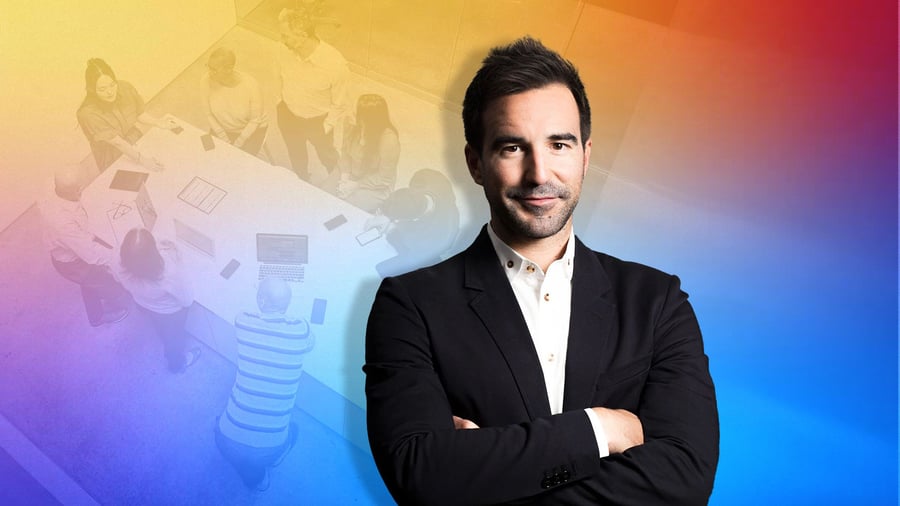
Tomas Chamorro-Premuzic is a critic of the cliche "Be yourself" often touted in many companies as a cultural promise. As an economics psychologist at the University College London, he argues that it's not the "true self" that counts in the workplace, but impact and the ability to present oneself accordingly. In his book "Don't Be Yourself", he criticizes the authenticity cult, explaining why leadership resembles good acting and why the employer promise "Here you can be completely yourself" often leads to disappointment.
Read the complete interview with Tomas Chamorro-Premuzic here. Chamorro-Premuzic says "Be yourself" at work is a bad idea. Why? The idea that one could express any spontaneous impulse at work unfiltered is unprofessional and hardly feasible in everyday life. We succeed when we control the version of ourselves we show - depending on the context, goal, and counterpart.
And if others see us as good to work with. This includes managing our emotions. Is this also true for leaders? Absolutely. Employees don't need to know the inner life of their boss. They need to be able to assess how he decides, communicates, and reacts under pressure. Leading effectively is key. What do you mean by emotional intelligence - if it's not about showing feelings?
Emotional intelligence means primarily understanding how my behavior affects others. And I consciously control my impact - so that cooperation is possible and goals are achievable. In short: social antennae plus self-control. Must managers play a role? Yes. Leadership is always a role - the question is whether it is played consciously and professionally.
Why? The first authentic response of a manager is often the wrong one. Leadership means editing: controlling impulses, dosing words - and yet appearing authentic. Ideally, the impression of authenticity emerges. The best leaders are masters of strategic authenticity: controlled without being artificial. Can you give an example from the leadership daily routine?
A team member proudly presents a result after long work. The direct and genuine reaction might be: "That can't be right." But if the boss says it exactly like that, he demotivates the colleague. If the manager reflexively praises the result as "great", he appears unconvincing. Professionally it's in the middle: honest, but so that the team member can grow.
What is the corresponding sentence in this case? Something like: "I see how much work is in there. There are two or three points we need to significantly improve - let's go through them together now." What is the decisive difference? They generate trust. It's not generated by unfiltered honesty, but by feedback that is clear - and makes others action-oriented.
Where is the line so it doesn't look staged? What matters is not how authentic one feels. What matters is whether others perceive you as authentic. You are "real" if you present a professional version of yourself that is appealing, without being pretentious. But leadership also means: contradiction, conflicts, power struggles. What is your most important tip?
Separate appeal and reaction. Those who react impulsively lose - often authority. And how to train this self-control, especially when the pulse is already high? I had to learn it myself. Once, I answered angry emails immediately and typed "No" three times. Today I let the message lie and answer later. Then a short, factual sentence or simply "o.k." is often enough.
Why is that important? Because it's about impact. To be an effective leader, you must be perceived as authentic - not "be authentic" in your innermost core. If you let the first impulse run unbridled, you lose this impact. If you edit yourself, you remain attachable - and are perceived as reliable. Does this point also apply to polarizing leaders, such as US President Donald Trump or entrepreneur Elon Musk?
Why do some find them "authentic" while others call them erratic? Many confuse erratic behavior - i.e., impulsiveness - with unpredictability. With Trump, the extreme example, the pattern is quite consistent: disruptive, contrarian, controversial, attention-seeking. Those who read this pattern as "authentic" call it authentic. Those who only see volatility at the moment call it erratic.
That's exactly the misunderstanding: authenticity is often just recognizability. If leadership is also a role: What must a manager never make into pure staging? Your behavior must serve the team - psychological security, clear standards, no poisoned atmosphere. Trust is not generated by unfiltered feelings, but by the fact that others feel you act in their interest.
And in which situation might it be necessary for a leader to consciously act against their instinct? A typical demand of the authenticity cult to managers is: "Stay true to your values no matter what happens." But I say: In leadership, you must be able to set aside your values at the moment to first listen. What does that mean in practice - in a time when CEOs are expected to take a stand on everything?
It's easy to follow and say: "I feel this way about X." Much harder, and more valuable, is for a leader not to reflexively make their values the yardstick for everyone, but to accept the possibility that they may not be the yardstick for everyone.
Written by urgent.news from Handelsblatt's reporting — not their text. Machine-written — may contain errors; check the original before relying on it.