Electronic skin for prosthetics senses temperature and pressure
A new electronic skin could someday be used to help amputees gain feeling in their prosthetics.
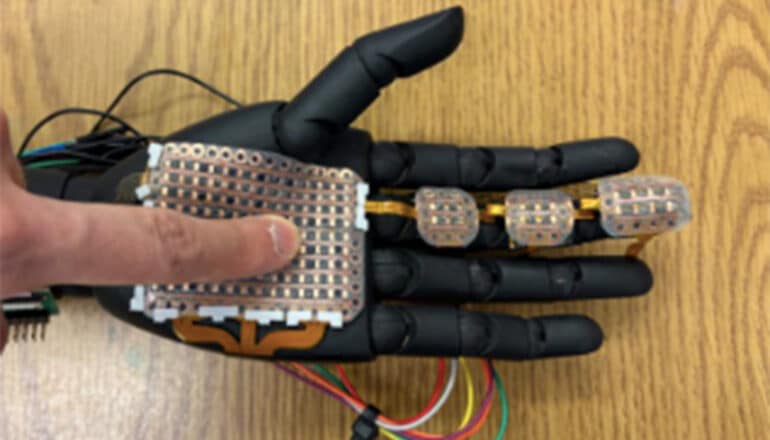
Researchers at Washington State University have developed electronic skin technology capable of sensing temperature and pressure, which could enable prosthetic limbs to provide a sense of touch to amputees. The innovative system, led by graduate student Hongyi Shen and published in the journal Cell Reports Physical Science, surpasses current commercial glove sensors by ten times in terms of scale.
This cutting-edge approach democratizes the production of medical-grade e-skins, making advanced tactile feedback attainable for widespread clinical use. Shen explains that this foundation is crucial for creating prosthetics with both sensing and haptic stimulation functions. While existing electronic skins exist, they are costly, lack high sensing resolution, and often suffer from poor fit and limited coverage.
Moreover, their complexity inhibits real-time performance due to the massive data generated. The WSU team addressed these shortcomings by designing a customizable sensing system that conforms to the unique shape of prosthetic limbs and closely replicates the sensing capabilities of natural human skin. Their sensor modules consist of thin-layered sandwiches with temperature and pressure sensors, enabling accurate human-like tactile sensing.
To fabricate these modules, the researchers employed a "scan-model-print" method, allowing for high-density sensing and personalized 3D fabrication. The scanner maps sensors based on the prosthetic geometry, ensuring seamless coverage over the freeform region. The sensors are robust, measuring both pressure and temperature with high density over flat or curved surfaces.
Instead of relying on adhesives, the modules snap together like Lego bricks, creating a simple and cost-effective manufacturing process. This research was supported by WSU's National Science Foundation Research Traineeship in Next-Generation Robotics and Qiu's startup funds. The team has applied for a provisional patent and is currently working on an actuator to convert the e-skin's sensing signals into stimulation for the amputee's nerves, ultimately enabling the user to perceive what they are touching.
Written by urgent.news from Futurity's reporting — not their text. Machine-written — may contain errors; check the original before relying on it.