Trump is pulling every lever to reshape U.S. elections
President Trump's playbook for reshaping America's elections targets who appears on voter rolls , how ballots move through the mail , who monitors polling places and where congressional lines are drawn. The effort leaves virtually no part of the election system untouched. Why it matters: Voting-rights experts say the churn is designed to sow confusion, deter turnout and undermine trust in…
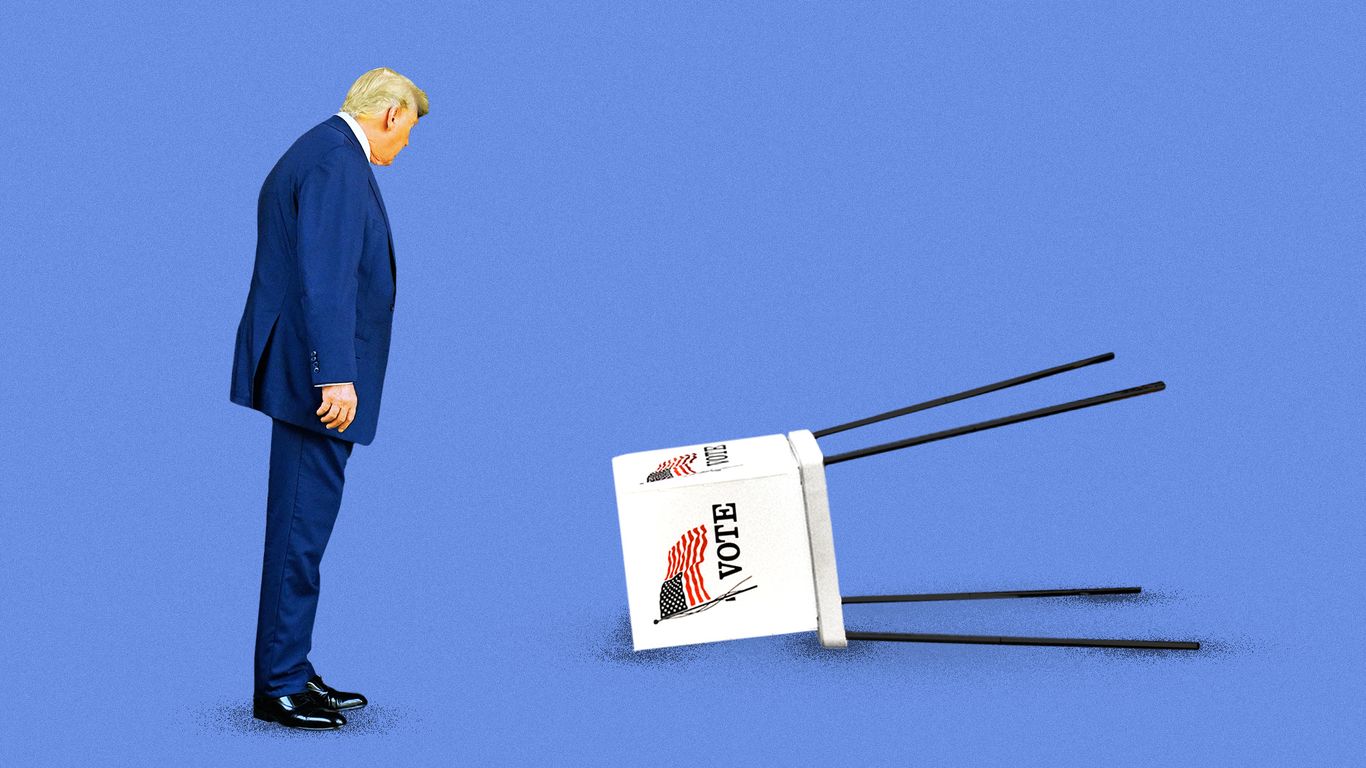
President Trump is employing every possible means to overhaul the United States' electoral system, targeting various aspects such as voter registration, mail delivery, polling place oversight, and congressional districting. These efforts are extensive, touching virtually every facet of the election process. Voting rights advocates argue that these changes aim to create confusion, discourage voter turnout, and diminish confidence in the democratic process.
Even measures that have been blocked by courts can sow uncertainty and erode public trust prior to Election Day.
A federal judge recently lifted a nationwide injunction on the administration's plan to overhaul the U.S. Postal Service's role in mail voting, just as states are set to begin mailing ballots. This plan mandates states to revise ballot envelopes and transmit voter rolls to the Postal Service. If an election office fails to comply with these new requirements, the Postal Service can reject the outgoing ballot mailing, compelling officials to rectify the issue before resubmitting.
Twenty-four attorneys general, including Pennsylvania Governor Josh Shapiro, have filed a lawsuit, contending that the plan imposes formidable tasks on states with limited resources.
The broader context reveals that Trump has been utilizing executive orders, federal agencies, Justice Department lawsuits, and his public platform to modify election rules, which are predominantly established by states and Congress. Andrew Garber, senior counsel at the Brennan Center for Justice, asserts that the president lacks constitutional authority to dictate election rules.
Garber states that there is no room within our system for the president to intervene in this manner. The ACLU's Molly McGrath notes that the president has been issuing unconstitutional executive orders, which generate confusion and erode trust in the electoral system.
Various methods have been employed by the president to reshape voting rights. He has directed the Department of Homeland Security (DHS) to compile state-by-state lists of confirmed U.S. citizens for electoral officials to verify during the registration process. Voting rights organizations caution that noncitizens rarely vote and criticize the often inaccurate citizenship lists that inadvertently include eligible voters.
The Department of Justice (DOJ) has also sought unredacted voter registration lists from most states, asserting that the data is necessary to enforce federal laws. However, 23 of these lawsuits have been dismissed, according to the Brennan Center, while others are still pending.
The SAVE Act, proposed by Trump, mandates proof of citizenship for voter registration. Advocates argue that such a requirement, akin to a modern-day poll tax, could disenfranchise approximately 21 million eligible voters, including women whose last names differ from their birth certificates and Americans without passports. The White House spokesperson, Lauren Bis, contends that Democrats are opposing "common-sense election integrity measures" supported by the vast majority of Americans.
The administration has also removed Democratic members of the U.S. Election Assistance Commission, which resisted Trump's proposal to include proof-of-citizenship requirements on federal voter registration forms.
Early voting is another area where Trump has expressed concern, urging Republicans to vote early while accusing Democrats of attempting to cheat. Restrictions on Sunday early voting, particularly during the "Souls to the Polls" tradition when Black churches transport their congregants to vote, could disrupt these long-standing practices.
Redistricting is another contentious issue, with Trump prompting Republican-led states to redraw congressional maps mid-decade, while Democratic-led states respond in kind. These redistricting changes could potentially award Republicans an electoral advantage, according to an Axios analysis.
The administration has also floated the idea of deploying federal agents and Immigration and Customs Enforcement (ICE) at polling places, though there is no concrete evidence of a deployment plan. Despite this rhetoric, DOJ has lost voter-data lawsuits thus far, and the SAVE Act has not passed the Senate. The legality of the Postal Service rule remains unresolved, even though it can now take effect.
Most of Trump's efforts to undermine the electoral process have failed, but the intention remains clear: to flood the system with confusion and fear, ultimately undermining voter confidence.
Written by urgent.news from Axios's reporting — not their text. Machine-written — may contain errors; check the original before relying on it.