Rural America’s eCommerce Transformation Arrives via Delivery Drone
Retail, since the category’s inception, has embraced the maxim that population density equals sales destiny. That calculus has largely held steady in the age of eCommerce and shifting customer expectations, too. After all, the economics of last-mile delivery improve when more customers can be packed onto the same route. A driver making 100 stops across […] The post Rural America’s eCommerce…
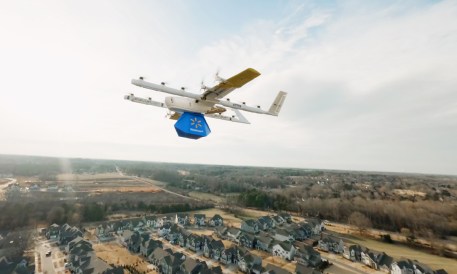
The retail industry has traditionally prioritized population density as the key to sales success. This sentiment remains largely unchanged in the era of e-commerce and evolving customer demands. Delivering to a location with 100 customers packed onto a single route proves more economical than making multiple trips to isolated households spread across vast distances.
Amazon recently announced its Prime Air drone delivery service will expand to nearly 500 U.S. cities and towns by the end of 2026, signaling a potential shift in the conventional retail equation. The farther customers live from one another, the more costly it becomes to serve them. In response, Walmart is taking a parallel approach by partnering with Alphabet’s Wing to establish drone infrastructure.
This emerging retail battleground, highlighted by recent headlines, demonstrates that low-density commerce is becoming a focal point of competition. Amazon and Walmart are leveraging technology to attract shoppers in suburban, exurban, smaller city, and eventually rural areas where conventional last-mile delivery remains inefficient.
Amazon's recent expansion marks a sixfold increase in its drone delivery footprint, reaching tens of millions of customers. Each Prime Air site covers about 175 square miles, with approximately millions of orders, including groceries, electronics, cosmetics, medications, and household items, delivered within 30 minutes. Although these sites are not yet classified as rural, they suggest a more intriguing geographic frontier than densely populated areas like Manhattan or downtown San Francisco.
Walmart's stores, once primarily destinations for in-person shopping, are now evolving into drone launch infrastructure. The company's extensive network of stores, situated close to the communities they serve, allows merchandise to be strategically positioned near the end consumer without the need for a separate network of fulfillment facilities.
By adding drone operations to this inventory, Walmart's supercenters can transform into multifaceted assets: stores, warehouses, pickup points, conventional delivery hubs, and autonomous fulfillment nodes. This strategic advantage is evident in Walmart's ability to address everyday needs, such as forgotten groceries, printer ink, or medications, through drone delivery.
The competition between Amazon and Walmart is not merely about Walmart becoming more like Amazon or vice versa. Instead, it revolves around Amazon making its fulfillment infrastructure resemble Walmart's store network and Walmart making its fulfillment infrastructure behave more like Amazon's. For decades, retailers have pondered the ideal distance to place a store relative to the customer.
However, e-commerce has shifted the focus to the proximity of inventory. With autonomous delivery, a new question arises: how significant is the distance between customers? As the retail landscape evolves, drones are poised to redefine the traditional delivery route, making it increasingly irrelevant.
Written by urgent.news from PYMNTS's reporting — not their text. Machine-written — may contain errors; check the original before relying on it.