Production Validation: The Missing Layer in Enterprise Releases
Production validation adds a critical business-control layer between testing and deployment, combining data checks, exception review, approvals, reconciliation and operational readiness before a release reaches production.
In an enterprise setting, production errors are frequently the result of insufficient testing, encompassing factors like readiness for release, data accuracy, exception management, and operational consent. Nonetheless, the missing component is not merely an increase in testing. It involves a rigorous, systematic review process to validate vital business data and release activities.
The issue extends beyond the impact on payroll, benefits, reporting, reconciliation, or other delicate operational processes. Production issues can also induce payment complications, downstream reporting inaccuracies, audit concerns, and operational disruptions. Production preparedness should be evaluated as a business-control question, rather than solely a software-quality concern.
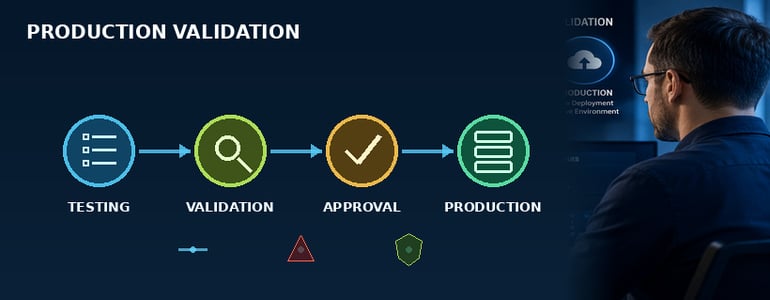
Figure 1 illustrates the enterprise release workflow with production validation as the operational discipline situated between standard release preparation and the deployment of modifications into the live environment. Its purpose is to ensure that important records, release outputs, and anticipated downstream effects have been adequately reviewed before modifications are introduced to the live environment.
Unlike binary testing validation, production validation incorporates assessments to ascertain if the data is comprehensive, exceptions are managed, discrepancies are resolved, and the release criteria are deemed suitable for production.
Production validation usually necessitates multiple perspectives on validation outcomes, reconciliation sign-offs between files, issue tracking results, and proof of approval, testing, and preparedness for operations. While testing is crucial, it does not address all questions regarding whether a specific code can be deployed to production.
Code may function correctly in a test environment yet encounter issues in production due to timing dependencies, data-state disparities, downstream dependencies, and business controls in the production environment, which may not be considered in standard testing cycles. Consequently, relying solely on testing can lead to late bug discovery, making them challenging to rectify once they have infiltrated a live application.
Production validation tackles this issue by treating release readiness as a formal gate instead of merely an assumption, as outlined in Table 1. Table 1 compares traditional testing with production validation, highlighting the primary focus of each: verifying software functionality versus operational and business readiness. While both aim to ensure quality, production validation expands the scope to include data integrity, release readiness, and operational governance.
This results in a more comprehensive approach to release evaluation, reducing the likelihood of bugs going undetected until production.
A practical model for production validation comprises a series of interconnected control practices that bolster confidence in an upcoming release before rollout, as depicted in Figure 2. The components include a structured pre-production review, exception review and correction, workflow-based release discipline, documentation and repeatability, and manual business-level validation.
The pre-production review involves checking some or all records and expected outputs against business rules and operational expectations to ensure key data changes are complete, expected outputs are present, and the release appears safe from a business-risk perspective before the release is sanctioned to proceed.
Exception review and correction involve generating reports of discrepancies, reviewing affected records, and ensuring issues are addressed before the release is moved to production. This practice helps prevent teams from dismissing exceptions as routine matters and emphasizes exception handling as part of release governance. Workflow-based release discipline ensures reliable releases by making the status of issues, validations, dependencies, and approvals explicit.
This helps confirm that a release is prepared for deployment not just because the team declares it ready but because it has achieved a valid state. Incorporating workflow-based governance provides better traceability of validation activities and minimizes the risk of overlooking critical validation steps to meet deadlines.
Standardized procedures, such as validation checklists and runbooks, promote consistency by employing documented approaches to release verification instead of relying on memory. This documentation not only fosters uniformity but also provides a defensible basis in high-risk environments requiring teams to justify their belief that a release is safe for delivery.
Manual business-level validation remains essential in critical scenarios where subjective decisions are involved. Reviewing releases at the business level, comparing expected and actual results, and analyzing differences can uncover issues that technical verification might overlook. Manual validation should not be viewed as a weakness as it often serves as the final check to determine if introducing a release into production is genuinely safe.
Written by urgent.news from DevOps.com's reporting — not their text. Machine-written — may contain errors; check the original before relying on it.