Mecca Agreement: A Security Alliance or a Saudi Attempt to Restore Its Image of Power?
The question is not whether Ankara and Islamabad are prepared to sign alongside Riyadh, but what they will do when Saudi Arabia comes under another attack from Iran or the Houthis, writes Bayethe Msimang.
Title: Mecca Agreement: Security Alliance or Saudi Image Restoration?
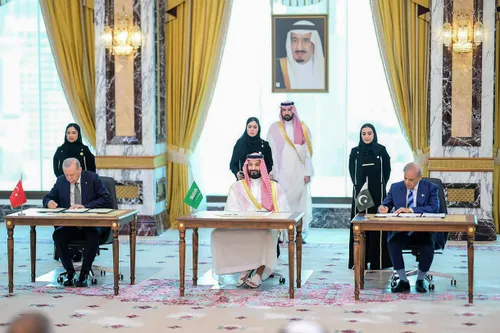
The "Mecca Agreement" signed by Saudi Arabia, Turkey, and Pakistan on August 7 has sparked discussions about the Middle East's potential for a lasting military alliance, especially as it commits to defending each other from attacks. However, the agreement currently lacks the necessary military and operational frameworks to function like Article 5 of the North Atlantic Treaty, according to Reuters.
The main purpose of the agreement goes beyond uniting three significant Muslim nations; it raises the question of whether it signifies a genuine shift in power dynamics or merely another Saudi attempt to establish a security umbrella, following several failed regional endeavors that did not meet their initial goals.
Critics argue that the agreement is just a repetition of previous failed attempts, such as the Arab League, the Arab Cooperation Council, the Gulf Cooperation Council, the Arab NATO, the Islamic Military Alliance, and the Saudi-led coalition against the Houthis in Yemen. Despite Saudi Arabia's claims that the coalition is still active, it has failed to achieve any of its objectives and could not defeat the Yemeni armed opposition.
The recurring issue lies in conflicting interests during crises and Saudi Arabia's inability to lead any alliance effectively.
Turkey, a NATO member, has extensive relations with Russia and Iran, while Pakistan's military decisions are primarily influenced by its conflict with India. Saudi Arabia, on the other hand, prioritizes the security of the Gulf, Iran, and Yemen. Pakistan, a historical partner of Riyadh, previously limited its involvement in the Saudi-led Yemen war after its parliament rejected participation in 2015.
The Saudi-Turkish rivalry remains significant, as the two nations have competed for regional power for years and differed over Qatar, the Muslim Brotherhood, Hamas, and Yemen, but have since managed to reconcile and cooperate.
The Mecca Agreement establishes a strong collective-deterrence concept on paper but fails to unite the three partners in a common adversary. This paradox raises questions about the existence of an agreed threat, which has historically sustained the cohesion of long-term military alliances. The agreement can also be viewed through Saudi domestic politics, with Crown Prince Mohammed bin Salman needing to reassert himself as a regional power after years of failed Yemen war and Iranian attacks.
The agreement may be more of a political and media move to portray Mohammed bin Salman as a leader capable of forming alliances than a military alliance.
Written by urgent.news from IOL's reporting — not their text. Machine-written — may contain errors; check the original before relying on it.