For the first time, AI guides surgeons through a brain tumor operation
The operation took place in May at the National Hospital for Neurology and Neurosurgery, part of University College London Hospitals NHS Foundation Trust. Health officials said it was the first successful AI-assisted operation to remove a brain tumor. Details were not released until Thursday while the patient, Rhys Hibbert, recovered. Read Entire Article
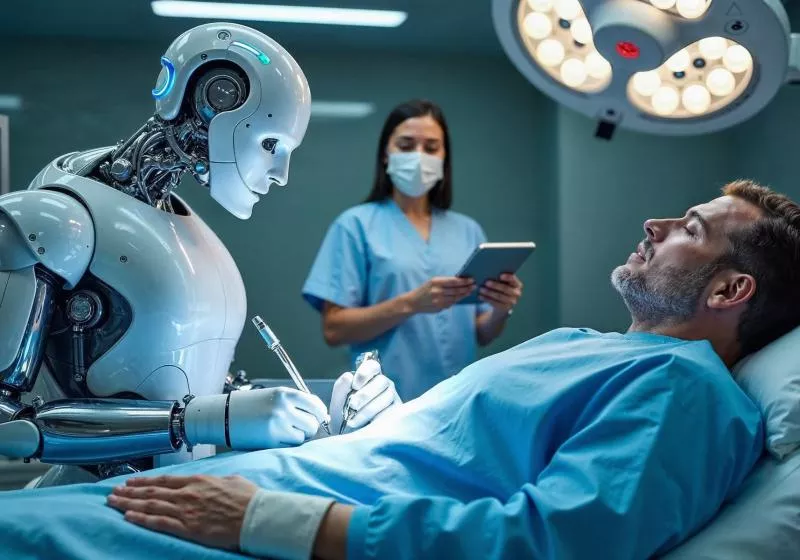
In a groundbreaking operation at a London hospital, surgeons employed artificial intelligence to assist in removing a brain tumor from a 48-year-old man, Rhys Hibbert, who faced the risk of losing his sight. Utilizing live video analysis during the procedure, the AI system meticulously identified and flagged nerves and blood vessels, allowing the surgical team to navigate around the tumor with utmost precision.
This unprecedented event, which took place in May at the National Hospital for Neurology and Neurosurgery, marks the first successful AI-assisted brain tumor removal.
Hibbert's tumor, measuring 11mm on his pituitary gland, posed significant challenges due to its proximity to critical nerves responsible for vision and major blood vessels. A slight mistake of even a millimeter could have resulted in blindness, stroke, or worse. The AI system, which had previously been used for research purposes at the hospital, color-coded the surgical field to aid doctors in identifying vital anatomical structures that required protection. Prior to this operation, the system had not been utilized during a live surgery on a patient.
Diagnosed in 2024, Hibbert initially managed his condition through non-surgical methods but subsequently experienced a severe hormone imbalance and deteriorating vision. Health officials stated that without the operation, Hibbert risked blindness. Fortunately, after the successful surgery, he reported that he could see everything in the room clearly and was able to walk without glasses or a walking stick within a week.
He has since returned to work as a customer service manager, expressing gratitude for the life-changing experience.
Dr. Sophia Bano, an associate professor in robotics and AI at University College London, led the technical development of the AI system. The software learned from hundreds of surgical videos, enabling it to recognize essential anatomy, surgical instruments, and tissue interactions as the operation progressed. Bano emphasized that the system's capability to identify critical elements in real-time provided surgeons with invaluable support during highly delicate procedures.
Funded by the National Institute for Health and Care Research as part of a clinical trial, this groundbreaking procedure demonstrates the potential of advanced AI to enhance surgical precision and improve patient outcomes. Mike Lewis, the institute's scientific director for innovation, highlighted the significance of this achievement, stating that it showcases how cutting-edge AI can support surgeons and significantly benefit patient care.
Hibbert acknowledged the hospital's rich history in neurosurgery, noting that the National Hospital for Neurology and Neurosurgery, founded in 1859, was the world's first dedicated neurosurgical hospital. The success of this AI-assisted operation at the same institution underscores the hospital's pioneering spirit in advancing medical technology and patient care.
Written by urgent.news from TechSpot's reporting — not their text. Machine-written — may contain errors; check the original before relying on it.