Drewry index edges lower on decline in trans-Pacific rates
The Drewry World Container Index fell in the latest week’s data on lower spot rates for trans-Pacific and Asia-Europe headhaul routes. The post Drewry index edges lower on decline in trans-Pacific rates appeared first on FreightWaves .
The Drewry World Container Index (WCI), a key indicator for global container freight rates, experienced a 1% decrease this week to $4,473 per forty-foot container. This decline was primarily attributed to lower spot rates on both the trans-Pacific and Asia-Europe trade routes. However, the overall market remains buoyant due to steady demand and carriers' effective management of capacity.
On the trans-Pacific lanes, specifically from Shanghai to New York, spot rates dropped by 2% to $9,333 per forty-foot container. Conversely, the Shanghai to Los Angeles route maintained its rates at $6,818 per forty-foot container. Drewry’s Container Capacity Insight noted that carriers have scheduled four blank sailings for the upcoming week, a decrease from seven this week, suggesting a rise in available capacity.
Despite the overall market uncertainty, Drewry anticipates that trans-Pacific rates will remain relatively stable and volatile in the following week. Similarly, rates on the Asia-Europe trade saw a 2% drop, with Shanghai to Genoa rates falling to $4,866 and Shanghai to Rotterdam rates decreasing to $4,287 per forty-foot container. The Asia-Europe route's capacity conditions are tighter compared to the trans-Pacific route, and carriers have announced four blank sailings for next week, up from two this week.
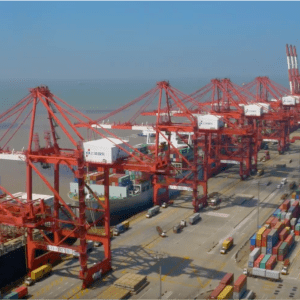
However, congestion at the Port of Shanghai has intensified, with average vessel waiting times rising to 96 hours from 35 hours the previous week. The broader east-west container freight market continues to face challenges due to geopolitical and operational pressures, with geopolitical tensions surrounding the Strait of Hormuz and carriers cautiously resuming Suez Canal transits after security assessments.
Additionally, congestion at Asian ports and low water levels on the Rhine are complicating vessel schedules and inland transport in Europe. The Panama Canal is set to reduce its transit capacity in September due to water constraints.
Written by urgent.news from FreightWaves's reporting — not their text. Machine-written — may contain errors; check the original before relying on it.