China’s humanoid robots aren’t smart enough to take your job — yet
Though the country's robot makers produce world-beating hardware, the humanoids currently lack the intelligence needed for general-purpose work, limiting their practical uses.
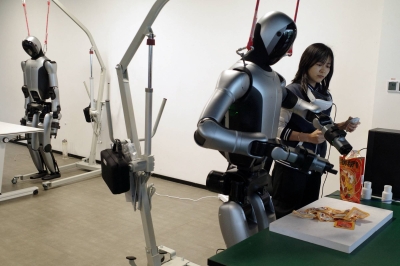
In a training center nestled in southern China, an impressive lineup of over 100 humanoid robots is on display. Each robot is accompanied by a dozen human trainers, equipped with advanced headsets, who painstakingly guide the machines through basic tasks such as sorting crates, packaging noodles, and brewing coffee. Despite their advanced technology, these robots exhibit slow and clumsy movements.
A trainee operator may only successfully guide a robot to perform a task correctly after 300 attempts, while an expert may achieve this in just 50 tries.
The humanoid robots are being supplied to a training facility by UBTech, a leading manufacturer of such machines. The Guangxi regional government recently awarded UBTech an $18 million contract to provide the robots and the necessary hardware for the program. The primary objective of this initiative is to generate training data for "embodied AI" — a term describing robots capable of perceiving, deciding, and acting within a physical environment.
To achieve this goal, the human trainers utilize specialized headsets that allow them to perceive the robots' surroundings and handheld controllers with integrated sensors. These devices enable trainers to translate their own movements into the robots' actions, effectively teaching the machines to navigate and interact with their environment.
While this technology holds promise for the future, it is clear that, at present, these humanoid robots are not yet intelligent or capable enough to replace human workers in most industries.
Written by urgent.news from Japan Times's reporting — not their text. Machine-written — may contain errors; check the original before relying on it.