35% of Subprime Consumers Remain Outside the Card Market
More than 1 in 3 subprime consumers sit outside the card market, leaving lenders and merchants with room to build a more manageable entry point to credit. The PYMNTS Intelligence report “Who Is the Subprime Consumer? A Behavioral Profile,” released in May, found that subprime consumers aren’t a small or temporary fringe. They represented 17% […] The post 35% of Subprime Consumers Remain Outside…
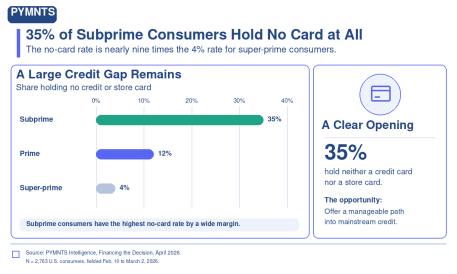
35% of subprime consumers remain unacquainted with the card market, presenting an opportunity for lenders and retailers to expand their reach. According to a May PYMNTS Intelligence report, subprime consumers constitute 17% of U.S. consumers, with their share fluctuating between 14% and 23% in 47 monthly surveys. A significant barrier to credit card adoption among subprime consumers is their lack of a card.
In February, 35% of subprime consumers held neither a credit card nor a store card, compared to 12% of prime consumers and 4% of super-prime consumers.
The disparity between subprime and prime consumers is stark, with the no-card rate nearly nine times greater for subprime consumers and approximately three times greater than the prime rate. This demographic segment presents a significant untapped market for conventional card rewards, credit-building features, and emergency spending capabilities.
Although store cards have penetrated this market to some extent, with 25% of subprime consumers holding both a store card and a general-purpose credit card, there remains ample room for growth.
The report suggests that product design could serve as a bridge to connect with this underserved segment. Features such as low-friction approval, a modest starting line, billing aligned with cash flow, and a clear pathway to a general-purpose card could provide a controlled avenue for subprime consumers to establish a payment history before transitioning to larger credit lines.
However, the opportunity is not without challenges. Nearly 55% of subprime consumers live paycheck to paycheck, struggling to meet their financial obligations while maintaining an average non-liquid savings balance of $3,138 in January.
Recent behavioral shifts also indicate a growing reliance on alternative payment methods. The share of subprime consumers carrying a card balance consistently or regularly declined from around half in mid-2023 to 38% in January. Furthermore, subprime consumers have increasingly turned to buy now, pay later services, though their usage was primarily concentrated among select providers.
Other insights revealed that young subprime consumers were deferring healthcare expenses, and many households utilized tax refunds as working capital.
Collectively, these findings underscore the potential for subprime consumers to respond positively to transparent pricing, modest credit limits, and payment schedules tailored to their actual cash flow. PYMNTS Intelligence, a trusted data provider, collaborates with businesses to gain insights that facilitate data-driven discussions on evolving customer expectations, a more interconnected economy, and strategic adjustments necessary for achieving desired outcomes.
With a team of experts, including PhDs, researchers, data analysts, and subject matter specialists, PYMNTS Intelligence offers rigorous research methodologies and unwavering commitment to objective quality.
Written by urgent.news from PYMNTS's reporting — not their text. Machine-written — may contain errors; check the original before relying on it.