14-year-old gamer builds adaptive VR controller after standard one didn't work
Fourteen-year-old Scott Merrow from Auburn, New Hampshire, could not grip the standard left-hand controller used for virtual reality games because of his “little hand”. Instead of giving up gaming, he worked with his mechanical engineer uncle to develop an adaptive VR controller. After three prototypes, Scott created a 3D-printed arm sleeve with a sensor that lets him control the game using…
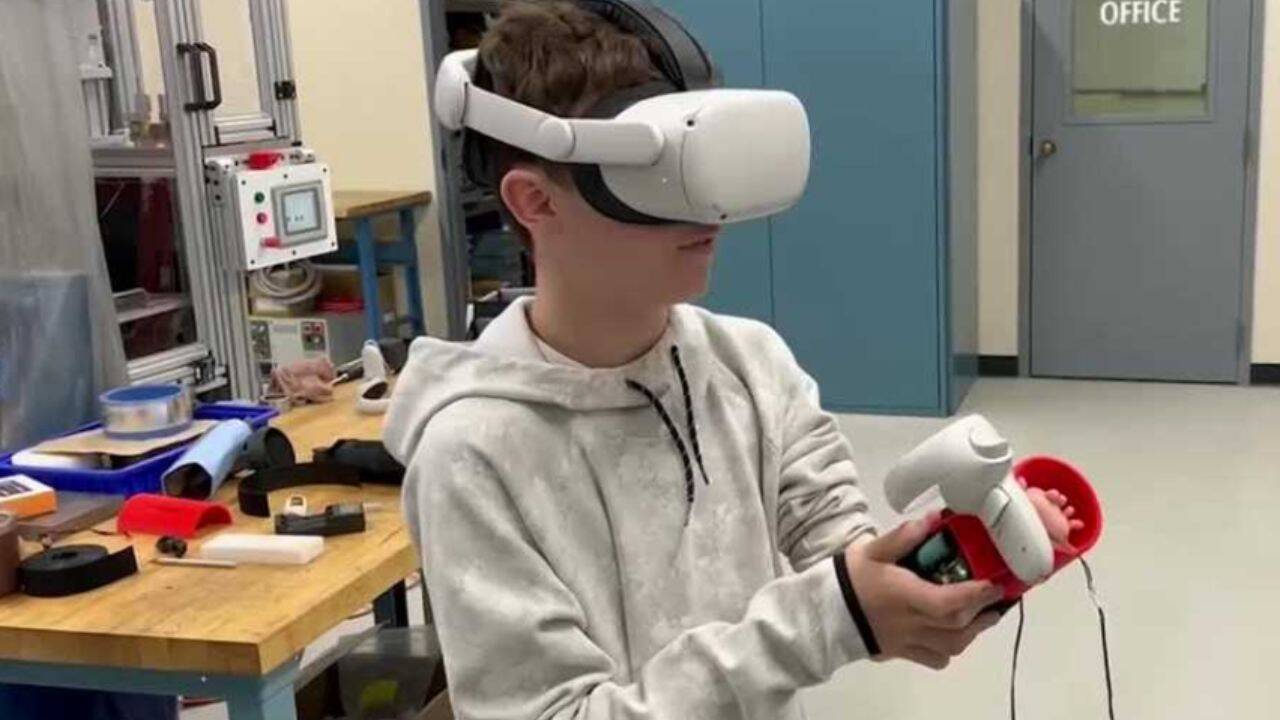
In Auburn, New Hampshire, 14-year-old gamer Scott Merrow has created an adaptive VR controller to overcome the limitations of standard controllers that do not suit his condition, symbrachydactyly. This condition affects the development of his fingers, leaving him with what he refers to as his "little hand." Scott has developed a unique method to use a traditional game controller by dividing its controls between his left and right hands.
However, this method does not work for virtual reality gaming, where controllers are designed to be held in each hand. Determined to find a solution, Scott decided to build an adaptive VR controller after his initial attempts with a traditional controller did not yield the desired results.
Scott's journey to creating his adaptive controller began as a school project, with the help of his uncle, Brandyn Lewis, a mechanical engineer. Together, they have gone through multiple versions of the controller, working at Lewis's shop at New Hampshire Ball Bearings. The latest prototype features a 3D-printed sleeve that wraps around Scott's arm, equipped with a sensor that can be pressed by the user.
The pressure applied by Scott is interpreted by a computer, which then sends signals to the VR controller, allowing him to operate controls without the need to grip the standard left-hand controller.
Scott's third prototype proved successful during a test when he used the controller to throw a paper airplane in a game using the left-handed controls. While the controller is not yet a final product, Scott remains committed to making adjustments and improvements. His invention has already gained recognition, winning second place in the New England region of the Invention Convention. Scott is set to participate in the national convention next month in Michigan.
Scott's mother, Kristine Merrow, notes that he has been comfortable explaining his invention and sharing his experience with others without needing much practice. Scott is also using social media to advocate for the adaptive community, receiving widespread support and encouragement. His father, Barry Merrow, expresses pride in Scott's determination and excitement to continue working on the project.
Written by urgent.news from Times of India's reporting — not their text. Machine-written — may contain errors; check the original before relying on it.