Zambia’s carbon registry could mark a turning point for Africa’s carbon market
In AugusT 2026, the Government of Zambia launched a fully operational national carbon registry, becoming the second African country after Ghana to combine live registry infrastructure with a signed bilateral agreement and a completed transaction.
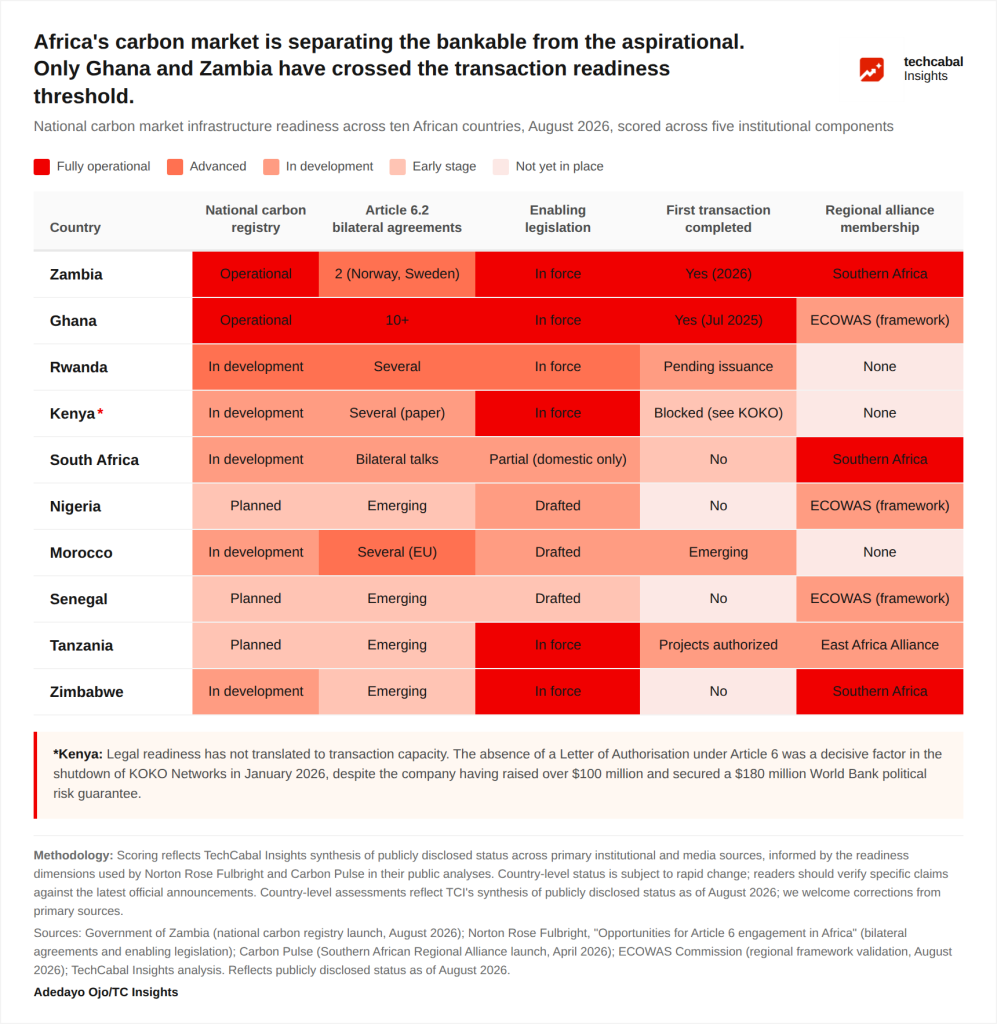
In January 2026, KOKO Networks, a leading African clean cooking company, ceased operations despite raising over $100 million in funding and receiving a $180 million World Bank guarantee. KOKO's ambitious clean cooking business aimed to replace charcoal with cleaner stoves, but it could not obtain the Kenyan government's approval to sell carbon credits necessary for its model's success.
Carbon credits are tradable certificates that certify a tonne of carbon dioxide (CO₂) was not released into the atmosphere, either through forest protection, cleaner stoves, or solar power. Governments and companies purchase these credits to offset emissions they cannot eliminate to meet regulatory obligations or net-zero commitments.
A carbon credit's price and legitimacy depend on its real, additional, permanent, and unique reduction. National registries verify these reductions, and Zambia's national carbon registry, launched in August 2026, marks a significant milestone. With a live transaction, an agreement with Norway, and a pipeline of developers, Zambia has now replicated Ghana's successful model, providing a guaranteed revenue stream for solar developers and ensuring credits' legitimacy for buyers like Norway.
This development is part of a broader trend across Africa, with at least ten Article 6 cooperation agreements signed by Ghana and a regional carbon market alliance launched by eight southern African countries. By 2030, the Africa Carbon Markets Initiative projects the continent's carbon market could scale nineteen-fold, generating $6 billion annually and supporting up to 30 million jobs.
However, several risks remain, including macroeconomic stability, as Zambia's recent sovereign debt default could affect credit underwriting.
Written by urgent.news from TechCabal's reporting — not their text. Machine-written — may contain errors; check the original before relying on it.