Tricentis Preps Wave of Additional AI Testing Capabilities
Tricentis is providing early access to multiple artificial intelligence (AI) capabilities that it is gearing up to roll out later this year via a Tricentis Transform initiative, including an autonomous AI agent, dubbed Aida, that explores web and Windows desktop applications to surface defects, weaknesses and other potential gaps without requiring DevSecOps teams to create […]
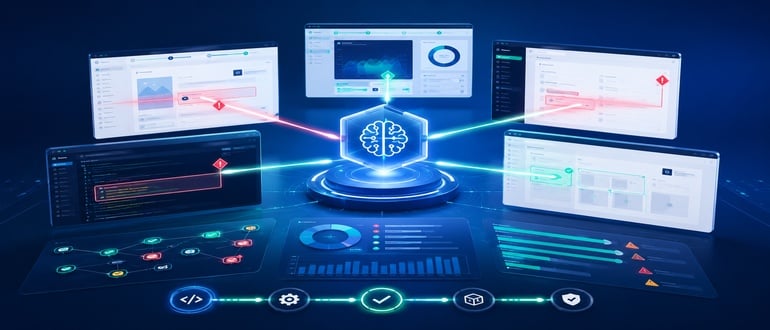
Tricentis is set to unveil a series of new artificial intelligence (AI) features as part of its Transform initiative, slated for release later this year. Among these advancements is an autonomous AI agent named Aida, which can independently explore web and Windows desktop applications to identify defects, weaknesses, and potential gaps without the need for DevSecOps teams to develop scripts.
In addition, Tricentis is developing a Release Risk Intelligence capability that highlights release-specific coverage gaps, prioritizes risks based on severity, and launches AI tasks to resolve the identified issues. This contextual information is provided by the automated Tricentis testing platform. Furthermore, the company is preparing AgentScore, a tool designed to assist organizations in evaluating AI agents by observing their behavior in real-world workflows, suggesting measurements, and generating composite quality scores, including recommendations for review, block, or ship.
David Colwell, Tricentis' vice president of AI and machine learning, emphasized that the overarching objective of the Transform initiative is to seamlessly integrate AI application testing into the development and deployment processes, rather than treating it as a separate function. This integration is expected to result in higher-quality applications that are inherently more secure.
The launch of the Transform initiative follows Tricentis' acquisition of Tabnine, a company that developed a knowledge graph enabling AI agents to discover relationships between various application components. This contextual insight is crucial for AI agents to automate tasks more reliably, according to Colwell. While the process of embedding AI agents into DevOps workflows is still in its early stages, the increasing generation of code through AI tools is placing greater demands on existing pipelines, primarily in the need to review and test code at machine speed.
The failure to meet this demand has already led to an increasing number of production incidents traced back to AI-generated code.
The timeline for reengineering DevOps workflows in the age of AI is uncertain, but it is evident that testing will become more integral. Colwell predicted that much of this testing will be conducted by AI agents reviewing and analyzing code created by other AI agents. The current challenge lies in the widening coverage gap, as the volume of generated code overwhelms DevOps teams' testing capabilities.
Eventually, the line between creating and testing code may blur, rendering the distinction between the two nearly meaningless. While specialists in testing applications will likely not disappear entirely, issues that require their expertise will become more valuable to resolve personally rather than relying on AI agents.
Written by urgent.news from DevOps.com's reporting — not their text. Machine-written — may contain errors; check the original before relying on it.