El Niño's warming effect is stronger than La Niña's cooling effect. How to accurately simulate this asymmetry?
A new study analyzed daily fluctuations in sea surface temperatures in hopes of gaining new insights.
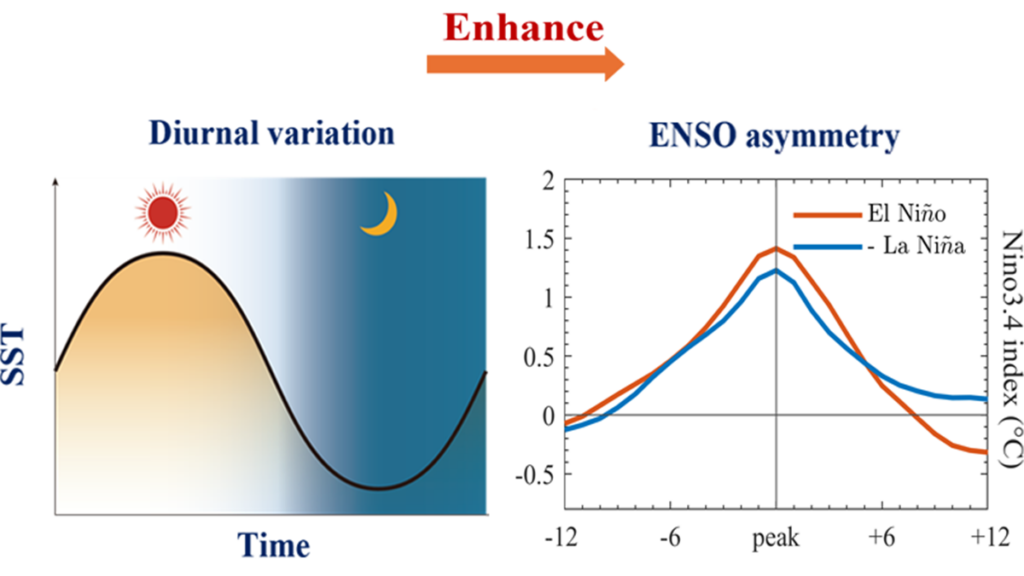
Researchers have found that incorporating a larger diurnal amplitude (DA) of sea surface temperature into climate models can improve the simulation of El Niño-Southern Oscillation (ENSO) asymmetry by up to 38.5%. ENSO asymmetry refers to the temperature difference between El Niño and La Niña events. A study published in Geophysical Research Letters used 35 models from the Coupled Model Intercomparison Project Phase 6 (CMIP6) and found that models with larger DA better captured ENSO asymmetry.
The mechanism is driven by the opposite differences in daily sea surface temperature anomalies in the central and eastern Pacific.
Written by urgent.news from Eos's report — not a translation of it. Machine-written — may contain errors; check the original before relying on it.