Is Dr Ndlozi's one-man manifesto a genuine call for change or an abandonment of true revolutionary thought?
Dr Ndlozi's newly unveiled manifesto promises radical change, yet critics question whether it is a retreat into liberalism, echoing past political failures and overlooking the essential role of state power in achieving true transformation.
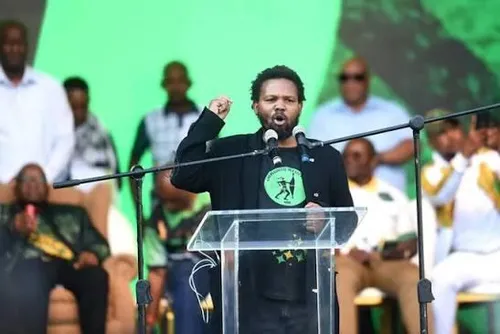
Dr Mbuyiseni Ndlozi, formerly a parliamentarian and now a podcaster, has unveiled what appears to be his personal manifesto for radical change. This concept seems to mirror initiatives recently unveiled by political figures such as Muzi Sikhakhane and Jacinta Ngobese, both of whom have also come under criticism for their lack of political engagement.
The initiatives, which have achieved mixed results, emphasize grassroots engagement with politics rather than overtly political actions. The initiatives appear to be inspired by Marxist ideas, specifically Karl Marx's "Theses on Feuerbach" from 1845, though this connection is not explicitly acknowledged.
Despite his academic background, Ndlozi presents these ideas as original, lacking any substantial contribution to the discourse. He appears to have abandoned the revolutionary cause and instead seeks to align himself with liberal NGO efforts in resistance, hoping such actions might lead to structural change. However, this approach has been attempted before and has not yielded significant results.
A brief examination of the 2002 Social Movements United (SMU) coalition, which included NGOs and various social movements, demonstrates that while these movements achieved a level of success, they ultimately failed to bring about substantial change. The SMU's efforts were a response to Thabo Mbeki's neoliberal policies, which commodified essential resources and resisted land redistribution despite holding power.
This historical context highlights the limitations of anti-state politics and the necessity of state power in bringing about change.
Ndlozi's manifesto fails to address the pivotal role of the state in facilitating social change, much like the Marxist theorist Vladimir Lenin, who emphasized the state's role as a tool for revolution. Instead of engaging with Lenin's ideas, Ndlozi's manifesto seems to rely on outdated liberal perspectives. The manifesto lacks critical examination of the key issues in South African society, such as white monopoly capital and settler colonialism, which are central to understanding the country's socio-political landscape.
Furthermore, Ndlozi's criticism of the political class appears to be blind to the ways in which the post-1994 state continues to serve the interests of white privilege. This oversight makes his critique seem hollow and unconvincing. Ultimately, Ndlozi's manifesto lacks the revolutionary thought and action required to drive meaningful change in South Africa.
Written by urgent.news from IOL's reporting — not their text. Machine-written — may contain errors; check the original before relying on it.