Inside the 'Pavilion of (Dis)sence,' a fight against Russia's weaponization of culture
In the lead-up to the Venice Art Biennale, posters for imagined cultural events began appearing throughout the city, each one carrying the disclaimer: "Canceled because the artist was killed by Russia." Conceived by exiled Russian artist Katia Margolis and curated by the Network Associazioni per Ucraina, the "Invisible Pavilion" was one of the most subtle yet striking protests against Russia's…
In the days leading up to the Venice Art Biennale, promotional posters for hypothetical cultural events emerged across Venice, each accompanied by a warning that the artist had been killed by Russia. This concept, known as the "Invisible Pavilion," was the brainchild of exiled Russian artist Katia Margolis and curated by the Network Associations for Ukraine.
The exhibition, now part of "Pavilion of (Dis)sence," is a joint effort by Memorial Italia and Arts Against Aggression, representing a collective artistic response to Russia's attempt to weaponize culture during its conflict with Ukraine.
Originally set to run from July 7 to August 7 in the former Church of San Leonardo, "Pavilion of (Dis)sence" has been extended by a month. The exhibition's title is a nod to the 1977 Venice Biennale, which brought together anti-Soviet dissidents from Eastern Europe, including artists who had been censored, persecuted, or forced into exile.
This was a bold statement that culture belongs to free individuals, not governments, and that artistic freedom cannot be detached from civic freedom and human rights, Margolis explained to the Kyiv Independent.
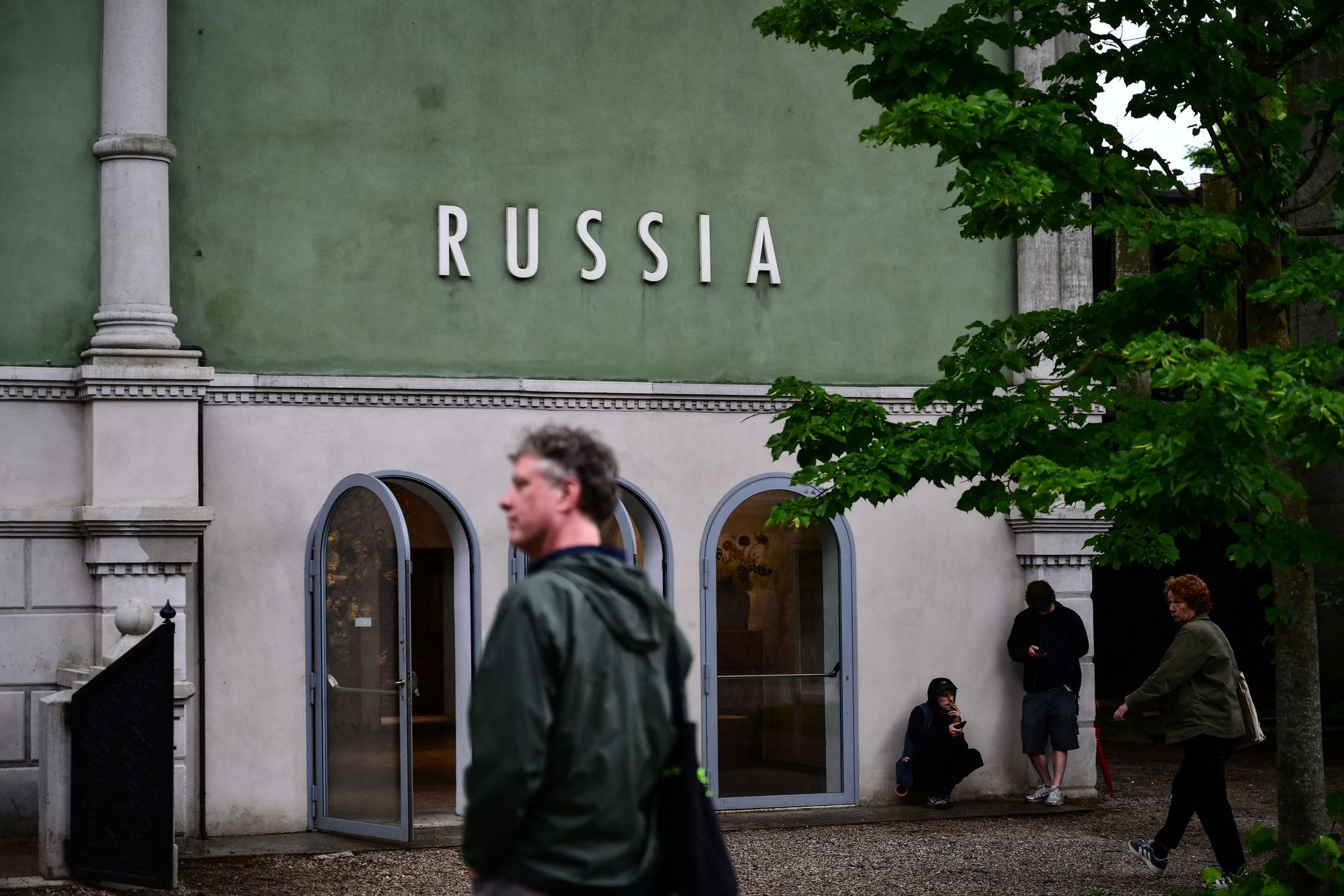
The irony lies in the fact that while the 1977 Biennale challenged Soviet cultural diplomacy, the 2026 Biennale chose to re-admit the official Russian Pavilion. "Pavilion of (Dis)sence" was born as a civic and artistic reaction to this decision. Russia did not participate in the Venice Art Biennale since 2022, when artists representing the country's pavilion walked out in protest against the ongoing war in Ukraine.
The Biennale's president dismissed the backlash against Russia's return to the event as "censorship," claiming it to be a "neutral space" for art.
The Russian pavilion is controlled by the Russian government, and its director, Anastasia Karneeva, has connections to the Russian military-industrial complex. Among the pro-war artists invited to participate, Margolis feels compelled to speak out against them. She believes that while artists do not need to create political art, they have a duty not to become pawns of those in power.
This is particularly important for Margolis, a pro-democracy Russian artist and activist living in Venice, who insists that Ukrainian voices must remain central in this ongoing struggle, rather than being sidelined once again by the powerful.
Written by urgent.news from Kyiv Independent's reporting — not their text. Machine-written — may contain errors; check the original before relying on it.