India’s Spacetech Ecosystem Looks To Microgravity For Drug Discovery And Manufacturing
Nearly seven decades after NASA began studying how matter behaves beyond Earth, microgravity research is entering a new phase: from…
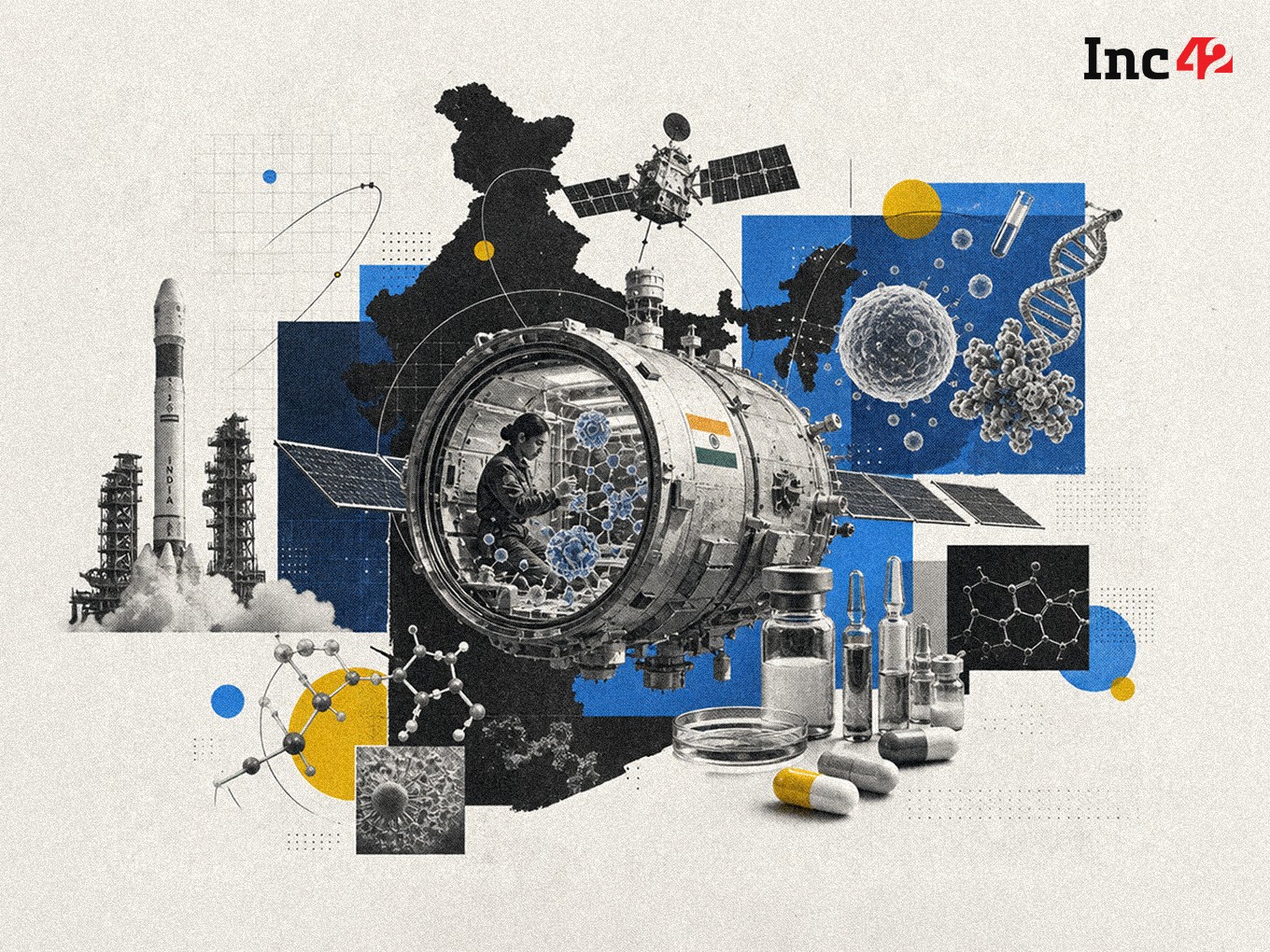
India’s spacetech sector is increasingly turning its attention towards microgravity for drug discovery and manufacturing. The unique conditions of microgravity, which enable researchers to grow high-quality protein crystals and study biological processes, are attracting the interest of pharmaceutical and biotech companies. The International Space Station (ISS) has become a primary platform for such research, hosting numerous experiments in biology, medicine, materials science, and fluid physics.
India’s space agency ISRO supported Indian astronaut Shubhanshu Shukla in conducting seven microgravity experiments during his 18-day mission on the ISS as part of Axiom Mission 4.
Indian startups are also exploring the potential of microgravity for manufacturing high-value products, particularly medicines. Odisha-based startup Serendipity recently flight-tested a prototype satellite designed to carry out critical pharmaceutical manufacturing steps under microgravity conditions. The satellite is intended to orbit at a distance of 400-500 km from Earth and return to Earth at specified locations, allowing for the retrieval of manufactured molecules.
Other companies like AnduraX and Akashalabdhi are developing reusable spaceplanes and inflatable modular habitats to support microgravity research and manufacturing.
The pharmaceuticals-in-microgravity market is valued at approximately $768 million in 2024 and is projected to grow to $3 billion by 2033, while the broader in-space manufacturing market is forecast to expand from $1.5 billion in 2026 to $3.5 billion by 2030. Indian entrepreneurs believe that the country’s strong talent pool, growing infrastructure, and thriving pharmaceutical ecosystem position India to play a significant role in shaping the global microgravity economy.
Written by urgent.news from Inc42's reporting — not their text. Machine-written — may contain errors; check the original before relying on it.