Guest Contribution: “The U.S. Household-Income Cycle and the Motio Rule”
Today we present a guest post written by Matías Scaglione and Romina Soria of Motio Research, an independent research firm focused on measuring and analyzing U.S. household income. Household income is central to economic well-being, but it is largely absent from the set of indicators used to monitor the U.S. economy at monthly frequency. Official household-income […]
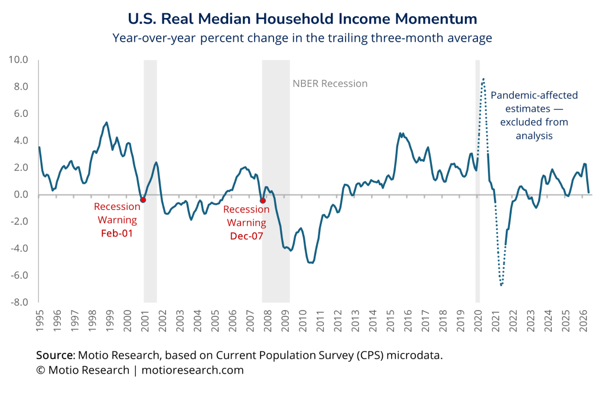
This guest post by Matías Scaglione and Romina Soria of Motio Research discusses their new monthly household-income series that extends back to January 1994. The series measures year-over-year percentage changes in the three-month moving average of real median household income, using Current Population Survey microdata.
Household-income momentum shows sustained positive readings during expansions and deterioration during expansions that preceded the 2001 and 2007-09 U.S. recessions. The pandemic recession did not follow a typical business-cycle pattern, and nonresponse bias affected CPS estimates during that time.
The researchers distinguish between confirmed phases—expansion and contraction—and transitional phases—candidate expansion and candidate contraction. Following a mature expansion, a U.S. recession warning is triggered when household-income momentum is negative for at least two consecutive months and has a combined depth of at least 0.5 percentage points. This warning is a dated event and is only issued once per mature expansion.
Written by urgent.news from Econbrowser's reporting — not their text. Machine-written — may contain errors; check the original before relying on it.