'Duck run' pest control catching on in winelands
Every morning, around 1 000 long-necked ducks are let loose on a South African wine farm to gobble up insects in an environmentally friendly method of pest control that is gaining popularity.
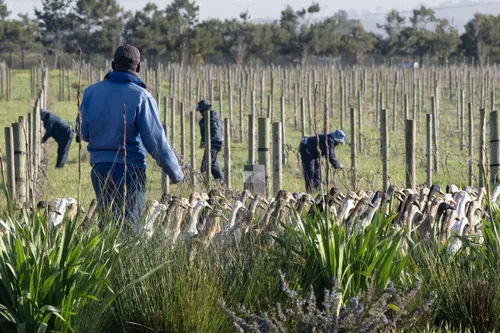
Every morning, approximately 1,000 long-necked ducks are released onto a South African wine farm to consume insects, showcasing an eco-friendly pest control method that is gaining traction. At 9 a.m., these upright and non-flying Indian Runner ducks are released from their pens at a farm near Stellenbosch, the wine-producing region outside Cape Town, to begin their work. After scouring the homestead and restaurant for aphids, worms, and snails, they move into the vineyards for the remainder of the day.
Vergenoegd Low Wine Estate and farm manager, Christiaan Cloete, explains that utilizing ducks instead of pesticides is more beneficial for the environment. He further elaborates, "When you use chemicals, you sometimes kill a lot of beneficial insects. We are trying to create a more biodiverse ecology in the vineyards."
The farm initiated this practice around 40 years ago, and it is now picking up in popularity. Between five to 10 neighboring farms purchase ducks from the estate. Presently, there are around 890 ducks on the property, with 400 hatchlings expected over the breeding season from mid-July to the end of October. Half of these will be sold, and the remaining ducks will replace older ducks in the farm's fleet.
Indian Runner ducks were originally developed in Indonesia to manage pests in rice paddies. Their long necks enable them to reach pests on trellised vines. Additionally, they aid in breaking down sheep and cattle manure, another regenerative farming practice that enriches the soil. Germishuizen notes, "The more pesticides and artificial fertilizers you put onto your soil, eventually your soil will degrade.
So by using natural methods ... we are really looking after our soils, which eventually does give us a much better product at the end of the day."
When grapes are present on the vines, the ducks are kept away to prevent them from consuming the fruit and are directed towards four irrigation dams. As they forage, their droppings enhance the water through a process called fertigation. Tessa Kleynhans, the commercial manager of the on-site hotel, mentions, "The impressive daily duck run has also become a draw for visitors.
We are trying to set the precedent for regenerative farming. We are trying to make a use case that, if you invest the capital in the beginning, even though it's a long, tedious process, it is worth it in the end."
Written by urgent.news from IOL's reporting — not their text. Machine-written — may contain errors; check the original before relying on it.