A New NASA Design Turbocharges Nuclear Spacecraft
The biggest threat to any crewed expedition to Mars is time . NASA’s shortest blueprint for sending people to the Red Planet and back requires spending 620 days in space and 30 days on Mars. Even setting aside the compounding challenges of building life-support systems that can operate without resupply for that long, or the fact that longer journeys leave more time for unlucky accidents, life in…
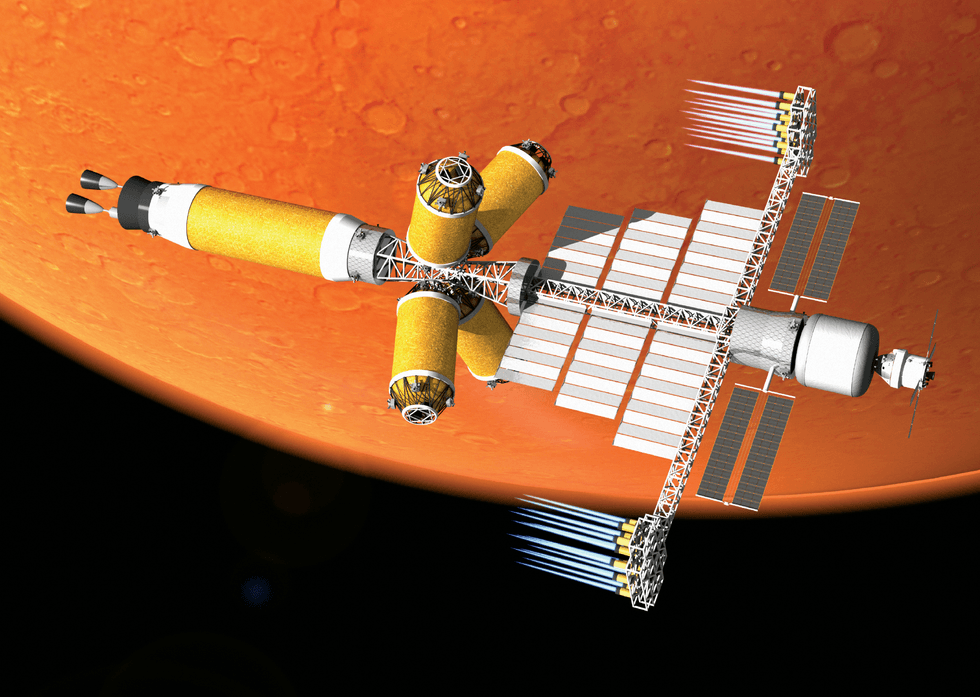
A new design by NASA could revolutionize nuclear-powered spacecraft, drastically reducing the time needed for crewed expeditions to Mars. Currently, a one-way trip to the Red Planet and back would require 620 days spent in space, not to mention the length of time spent on the planet itself. This extended duration increases the risk of complications due to prolonged exposure to space radiation and microgravity, as well as the challenges of sustaining life-support systems without resupply.
The key to reducing this time frame lies in the development of a bimodal nuclear rocket. In the 1960s, the U.S. conducted ground tests of nuclear thermal rockets as part of the NERVA and Rover projects. These experiments demonstrated much of the technology necessary for such rockets, including the use of liquid hydrogen as a propellant heated to temperatures of over 2,700 kelvin, resulting in a specific impulse of 900 seconds or more.
A bimodal nuclear rocket combines the benefits of both nuclear thermal propulsion and nuclear electric propulsion. While the Rover and NERVA programs successfully tested nuclear thermal rockets, they were ultimately discontinued in 1973 due to shifting political and budgetary priorities. However, recent interest has resurfaced, with various projects like the System for Nuclear Auxiliary Power (SNAP) and Demonstration Rocket for Agile Cislunar Operations (DRACO) demonstrating new possibilities for nuclear propulsion.
A bimodal nuclear rocket would integrate a nuclear reactor to generate electricity for powering spacecraft systems, while also providing thrust through a nuclear thermal propulsion system. This dual approach could enable faster transit times to Mars, allowing spacecraft to spend less time exposed to the harsh conditions of space and minimizing the risk to astronauts. With the ongoing research and development of bimodal nuclear rockets, the future of space exploration may soon become significantly faster and safer.
Written by urgent.news from IEEE Spectrum's reporting — not their text. Machine-written — may contain errors; check the original before relying on it.