What the World’s Nightscapes Reveal About Our Dependence on Artificial Light
An image of Earth at night as seen from space appeared on my laptop screen during an internet search. The captivating image with a vague title—“Global Map”—drew me in like an insect mesmerized by the warm glow of a streetlamp
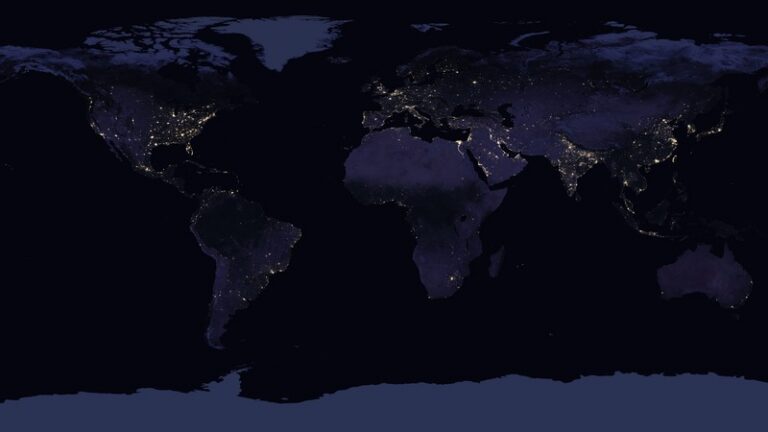
An image of Earth at night emerged on my laptop screen during an internet search. The alluring image, labeled "Global Map," captivated me as if I were enticed by the warm glow of a streetlamp at night. At first, the map reminded me of flying under the stars at night, dotted with illuminated cities, suburbs, and roads nearing the horizon, but on a much greater scale.
Despite the immense distance, identifiable locales emerged from the artificial lightprint. Majestic metropolises such as Paris, Delhi, Johannesburg, Mexico City, and the vibrant expansion of Cairo, along with the luminous "snake" of the Nile River, were visible. The map's simple yet striking aesthetic, alternating shades of dark blue and yellow, emphasized the stark contrast between darkness and illumination.
It made me ponder the implications of living predominantly in daylight. This map unveiled another side to the story, one often neglected or overlooked due to an unconscious preference for daytime. Night, characterized by the absence of sunlight, was still visible in certain areas due to moonlight, but it was even more remarkable for the extent and intensity of artificial light visible from space.
Some scientists refer to such illumination as "light pollution," defined as adverse artificial light at night due to its negative impacts on scientific research, ecology, human health, aesthetics, and more. However, not all scientists studying nocturnal artificial light agree on what constitutes "adverse." Other scientists offer a technical definition: "an increased concentration of photons in the nocturnal environment beyond naturally expected values."
This explanation, though precise, fails to capture the emotional impact of the map—an illustration of human presence on the planet and the resultant proliferation of artificial light. The map's power lies in its ability to challenge our perception of night, revealing its illuminating influence. As a historian, I was intrigued by the thought that the map might have looked different if captured in other eras, such as 1912 or 1812.
My journey led me to write a book, *Transforming Night*, exploring the history of artificial light at night and the scientists who raised concerns about it. My research began with astronomers, the first individuals to question the effects of nocturnal artificial light. Many observatories were established in or near city centers before widespread nighttime illumination, but as artificial light, air pollution, and vibrations from new transit systems increased, many observatories closed, repurposed, or moved to less urban areas.
This pattern is evident in Mexico's Observatorio Astronómico Nacional, founded in Mexico City and relocated four times between 1867 and 1969. The story of Mexico's observatory highlights three ways artificial light has transformed night: increased size and brightness, leading to the adoption of white light-emitting diodes (LEDs).
These LED lights have resulted in brighter cityscapes with white luminous hazy lights, altering the appearance of the night sky. The recent environmental concerns about nocturnal artificial light suggest that the modern nightscapes have become inverted, with bright lights dotting the Earth's surface, casting a luminous haze above celestial bodies, obstructing the natural visibility of stars.
Some scientists and activists argue that the daily experiences of night are becoming less "night-like," particularly in densely illuminated cities like Hong Kong. Residents now experience what scientists call "artificial twilight," a constant luminous environment where daylight never entirely gives way to nocturnal darkness. This raises the question: Is night without natural darkness still truly night?
Written by urgent.news from Literary Hub's reporting — not their text. Machine-written — may contain errors; check the original before relying on it.