What Hieronymus Bosch’s Fantastical Tryptiches Reveal About the Artist’s Worldview
While Giotto sought to communicate the Christian messages that he had been commissioned to depict by encouraging his viewers to empathize with the characters in his realistic scenes, Hieronymus Bosch (c. 1450-1516) took a different tack. In his paintings, the
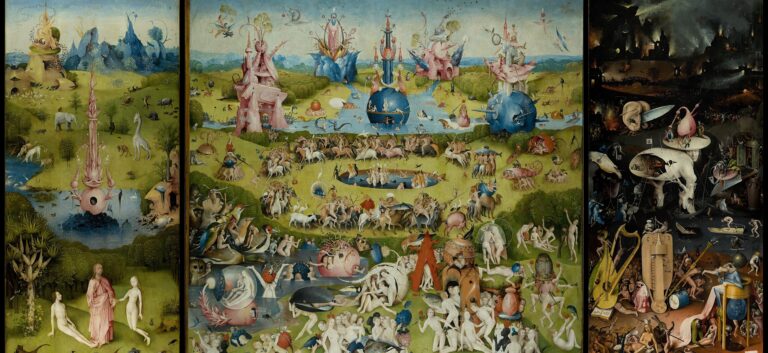
Hieronymus Bosch, a Netherlandish artist from around 1450 to 1516, approached his art in a unique manner compared to his contemporaries. While Giotto aimed to convey Christian messages through realistic scenes designed to elicit empathy from viewers, Bosch utilized humor and fantasy to draw his audience into a bizarre, tempting, yet perilous world.
However, this distinctive method of creating art and engaging with his audience is not immediately apparent to today's viewers and can only be understood with an appreciation of Bosch's worldview.
Notably, Bosch's most renowned work, The Garden of Earthly Delights, is a triptych, a three-panel painting, believed to have been created for a secular setting rather than a religious one. This triptych, now housed at the Prado Museum in Madrid, is one of the most enigmatic and challenging paintings in European art history. Unlike traditional religious art that focused on Biblical subjects, Bosch's triptych includes scenes of everyday humans on Earth, set against a fantastical landscape filled with lush vegetation, ponds, rivers, and giant fruit.
The central panel depicts hundreds of naked individuals indulging in various pleasures, frolicking and reveling in a world seemingly devoid of reality. The vibrant colors, ranging from reds, greens, blues, and pinks, evoke an atmosphere of unrestrained desire and enjoyment. Immersed in this colorful scene, some ride on giant birds, while others partake in luscious berries or pluck fruit from the trees.
The overall composition exudes an orgiastic energy as bodies intermingle, tumble, and intertwine, creating an almost chaotic scene.
To guide viewers in interpreting this central scene, Bosch provided side panels that maintain the same visual language but are more overtly religious in nature. On the left panel, we see God presenting Eve to Adam in the Garden of Eden. Although Eve remains innocent at this point, there are subtle hints of the impending evil that will be introduced into the world, as evidenced by the presence of a cat with a mouse in its mouth and a lion devouring a deer.
Conversely, the right-hand panel presents a stark vision of hell, featuring an array of demons and damned souls. Among these eerie figures are creatures with unusual features, such as a set of giant human ears with a knife protruding from between them, a man with a musical instrument up his backside, and even a pig dressed as a nun.
The two outer panels, designed to close around the central panel, depict a newly created world within a giant bubble, with God observing from afar. The entire work was likely commissioned by Engelbert II, Count of Nassau, for his palace in Brussels between approximately 1495 and 1504. The painting, along with the rest of Bosch's art, has continued to captivate, challenge, and intrigue viewers for centuries.
Despite its enigmatic nature, it is clear that Bosch's intentions were deeply serious, and his worldview was much more pessimistic than his unconventional art might suggest at first glance.
Written by urgent.news from Literary Hub's reporting — not their text. Machine-written — may contain errors; check the original before relying on it.