Tennessee company recycles old wind turbine blades into 99.9% pure glass fibre
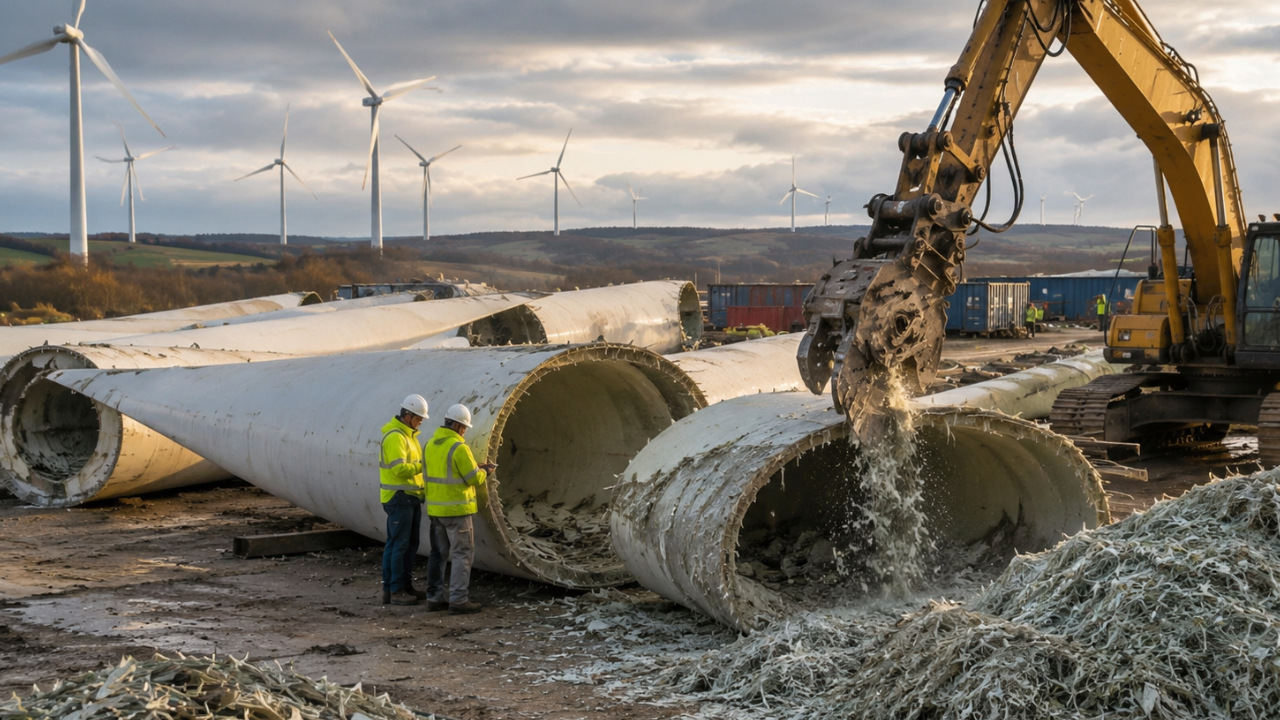
Carbon Rivers, a Knoxville-based advanced materials company, is pioneering a method to recycle retired wind turbine blades into high-purity glass fibre, presenting a potential solution to the growing waste issue posed by older turbines reaching the end of their operational lives. The US Department of Energy (DOE) reports that Carbon Rivers has achieved a 99.9% purity in recovered glass fibre, enabling the material's reuse in various products, such as composite panels, construction materials, and 3D-printing filament.
This technology has garnered millions of dollars in federal support and has been collaboratively researched with the University of Tennessee, Knoxville.
Traditionally, wind turbine recycling has been challenging due to the composite materials used in blades, composed of glass fibres embedded in tough polymer resins, which are designed to withstand fatigue, weather, and mechanical stress. Pyrolysis, a heat-based process, is employed by Carbon Rivers to separate these components. The process involves heating the composite in the absence of oxygen, causing the organic resin and polymer to break down while the inorganic glass fibres remain intact. The recovered fibres are then cleaned and prepared for reuse in various manufacturing applications.
The US DOE estimates that about 85% to 90% of a wind turbine's mass can currently be recycled, leaving fibre-reinforced composites as a major challenge. In 2024, the DOE announced $20 million in funding for improving the recycling of wind-energy technologies, focusing on difficult materials like those used in turbine blades. Carbon Rivers' technology has received significant government support, including $2.4 million from the DOE's Wind Energy Technologies Office and Small Business Technology Transfer programme between 2019 and 2022.
The company has processed over 100 tons of wind turbine blades into various products, including non-woven mats, thermoplastic pellets, and 3D-printing filament.
The primary advantage of the recovered glass fibre is its reusability in manufacturing applications, reducing waste and dependence on newly manufactured fibreglass. Potential applications include non-woven mats, continuous textile yarns, thermoplastic pellets, automotive sheet-moulding compounds, and filament for 3D printing. The recovered material can also be incorporated into construction materials or blended with virgin fibreglass for other uses, potentially forming a more circular system.
Carbon Rivers has explored applications beyond wind energy, including automotive, marine, and structural composite materials, expanding the market for recycled materials.
Written by urgent.news from Times of India's reporting — not their text. Machine-written — may contain errors; check the original before relying on it.