India’s Very Own ‘Tale Of Two Cities’ Of The Contemporary Times
"It was the best of times, it was the worst of times, .... it was the spring of hope, it was the winter of despair..." These immortal opening lines of the novel ‘A Tale of Two Cities’ by Charles Dickens seem to be relevant in contemporary India. Economic Gains And Hope Over the past decade, the Union government has done some creditable things to give us hope. Among large economies, India is…
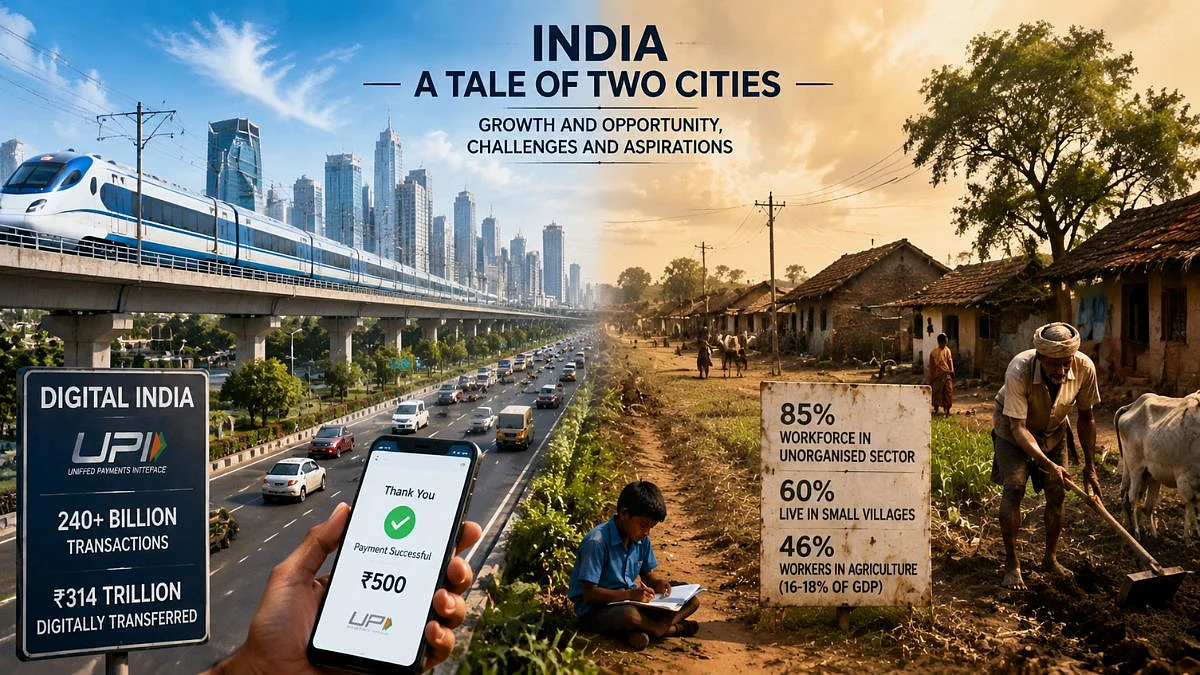
The contrasting realities of contemporary India resemble the "Tale of Two Cities" of Charles Dickens. In recent years, the Union government has demonstrated commendable efforts to instill hope. India stands out among major economies in managing the COVID-19 pandemic, geopolitical tensions, and fiscal responsibility. The government managed to curb the fiscal deficit from a record high of 9.2% in 2020-21 to 4.8% in 2025-26, with a target of 4.4% for FY 2027, despite the impact of the Hormuz Strait closure.
The financial sector has also seen significant improvement, with public sector banks posting an aggregate net profit of Rs 1,98,000 crore in 2025-26, after a loss of over Rs 85,000 crore in 2017-18. The proportion of non-performing assets in these banks has drastically dropped from 14.6% in 2018 to a historic low of 1.93%.
Infrastructure development has been a standout achievement, with the road network expanding from approximately 91,000 km in 2014 to over 146,000 km in 2026. Highway and road networks grew from 18,000 km to 48,000 km, while high-speed corridors increased from 93 km to 2138 km. The annual economic growth rate has remained strong at 6.5-7%, even amidst trade barriers and energy supply disruptions.
Digital technology has also played a vital role in welfare delivery, with the unified payment interface (UPI) handling over 240 billion transactions and transferring over Rs 314 trillion.
However, India faces formidable challenges in achieving inclusive growth. A majority of the workforce remains in the unorganised sector without a secure job and monthly wage, and over 60% still reside in small villages with limited upward mobility. Up to 46% of workers still depend on agriculture as their primary occupation, despite its declining contribution to the GDP.
Despite these challenges, India's growth is real and impressive but has not yet translated into significant improvements in the lives of people on a large scale. The formal sector is unable to absorb the 12 million workers entering the job market annually, and urbanisation remains sluggish compared to other major economies.
To address these issues, comprehensive national consensus, determination, innovative policies, competent execution, patience, and perseverance are essential. The growth must be accompanied by a massive national effort over the next two decades to generate inclusive, sustained high growth. This can be achieved by improving educational outcomes and skill levels, enhancing the growth model to be more inclusive and employment-generating, and implementing critical governance reforms.
These reforms include genuine empowerment of local governments, democratisation of political parties, electoral system reform, and ensuring a robust rule of law that delivers justice and incentivises socially productive behaviours.
Written by urgent.news from Free Press Journal's reporting — not their text. Machine-written — may contain errors; check the original before relying on it.