Urgent.News

What's breaking now, across thousands of outlets.

Tech

Der Chip-Gigant im Zentrum des KI-Booms: Einmal mehr macht Nvidia die Börsen nervös

Für die Weltwirtschaft ist das Finanzergebnis von Nvidia so wichtig wie ein Zinsentscheid der US-Notenbank. Bei den Quartalszahlen muss unbedingt ein positives Ergebnis her, sonst droht ein Markteinbruch.

Der Chip-Gigant im Zentrum des KI-Booms: Einmal mehr macht Nvidia die Börsen nervös

Nvidia, the semiconductor giant, finds itself at the epicenter of the ongoing AI boom. The company's financial results are as crucial to the global economy as a Federal Reserve interest rate decision. Nvidia's quarterly numbers are crucial in determining whether investors believe the AI boom will continue or not. If the numbers disappoint on Wednesday, it could trigger a correction or even a stock market crash.

The AI boom in its current form would be endangered. Companies involved in the AI revolution span various industries, including AI developers like OpenAI, hyperscalers like Amazon, and chip suppliers, as well as energy companies and technology suppliers. Nvidia remains the most important "chips manufacturer". Without its high-performance chips, building a robust AI infrastructure is unthinkable.

Analysts at Morningstar see no risk to Nvidia's competitive advantage. Should Nvidia hint at a slowdown in revenue growth in the second quarter, the stock market could take a disastrous turn. Nvidia has always managed to surprise doubters, exceeding profit forecasts in each of the last 14 quarters since the AI boom began in late 2022.

The company's market value is around $5 trillion. Observers also expect Nvidia to beat expectations in the second quarter, doubling the quarterly revenue and achieving nearly 100% year-on-year profit growth. Regardless of the outcome, Nvidia's earnings will trigger market fluctuations that affect the entire market. Investors tend to sell Nvidia shares even after record profits and take profits.

After years of strong stock gains, Nvidia must settle for moderate growth this year. Broad technology indices such as the Nasdaq or the Philadelphia Semiconductor Index, which reflects the chip industry, have been on a steady upward trend for months. Fluctuations and regular market dips reflect investor nervousness. There are also early signs of damage, such as the collapse of a hedge fund specializing in AI stocks, Situational Awareness, in July.

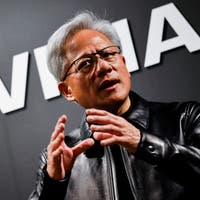
Nvidia co-founder and CEO Jensen Huang insists that the AI revolution is only just beginning and spreads optimism wherever he goes. He dismisses concerns about circular financing structures as "ridiculous". Nvidia is at the center of a network of AI companies that buy and invest in each other. Huang describes these investments as merely financial guarantees, a sign of "confidence in companies that shape an entire generation".

Large hyperscalers have had to take on debt and issue bonds to fund their massive AI investments. This type of financing is not inherently problematic, but Huang wants to ensure that financing capabilities do not diminish. At the beginning of the month, Nvidia joined forces with six financial institutions to launch a financing plan of over $500 billion for AI expansion.

Notable names like Goldman Sachs, Blackrock, or KKR are participating. If fully implemented, this would be one of the largest private financing initiatives on Wall Street. It is a series of capital pools through which Nvidia customers can secure and finance themselves. Huang sees computing power as a new, investable asset class, a "capital market for AI infrastructure".

In addition to financing, Nvidia has also entered the realm of language models. Recently, the chip giant invested $6 billion in an open language model from the startup Poolside. In March, Nvidia also engaged with Thinking Machines Labs, another open AI model. In this way, Nvidia covers more and more of the AI value chain and becomes increasingly indispensable for the industry.

All AI stakeholders have a vested interest in Nvidia continuing to present strong numbers. The CEO needs fresh money for AI expansion, and he plans to raise a lot of money from external investors through financial institutions like Goldman Sachs, Blackrock, or KKR. The risks are high given the feared AI bubble. Nvidia is a major winner of the AI boom, but the company's success also depends on supply chains that others control, notably Korean chipmaker SK Hynix.

Building a data center requires not only computer chips, but first and foremost a large excavation site and a lot of electricity, which benefits American companies that have nothing to do with AI.

Written by urgent.news from NZZ Wirtschaft's reporting — not their text. Machine-written — may contain errors; check the original before relying on it.
Read the original at nzz.ch →

More in Tech

More from Tuesday 25 August →