Trump Suddenly Wants a Summit With Kim Jong Un. Why Now?
With the Iran war stalled and Seoul slow to deliver on a $350 billion pledge, the U.S. president is dangling a one-on-one summit that could sideline South Korea.
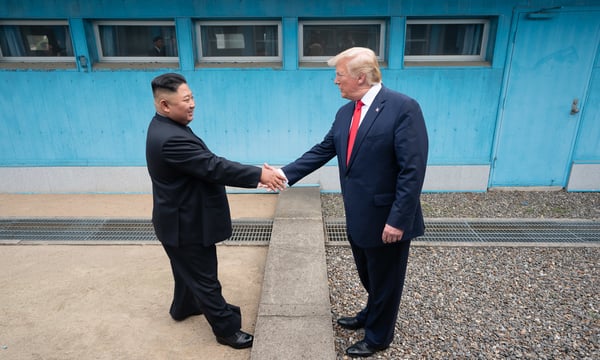
President Donald Trump unexpectedly announced his desire for a summit with North Korean leader Kim Jong Un on August 16, 2023. The former president shared an old photograph of the two men meeting at the Demilitarized Zone in 2019, highlighting the lack of smiles and the somber atmosphere. Later that day, Trump ordered the Pentagon to reduce joint military exercises with South Korea, citing a "very good relationship" with Kim as a reason for the change.
The Wall Street Journal reported that Trump was pushing aides to arrange a potential face-to-face meeting between himself and Kim as early as November, during the Asia-Pacific Economic Cooperation summit in Shenzhen, China. This sudden push for a summit raises questions about the timing and motivations behind it. Domestic political considerations appear to be the primary driver.
The Iran war, which Trump has been waging, remains unresolved and unpopular among the public. By focusing on a potential summit with North Korea, Trump could shift the narrative away from Iran, generating positive headlines that could benefit his political standing ahead of the November 3 midterm elections. North Korea, on the other hand, has little incentive to help rescue Trump from his current low approval ratings tied to the Iran war.
Additionally, South Korea's promised $350 billion in investment as part of a tariff deal has been slow to materialize, leading to Trump's frustration with Seoul's perceived slowness in honoring its commitments. The drawdown of joint military exercises was, therefore, framed as a favor to Kim while simultaneously jabbing at South Korea for its perceived lack of support in the Iran war.
The decision to reduce the exercises and push for a summit sends a clear message to Pyongyang that the United States can deal with North Korea directly, without the need for South Korean mediation - a move that comes at a time when the alliance with South Korea is already strained over financial matters. Despite North Korea's reluctance to engage in denuclearization negotiations, Trump maintains that Kim has responded positively to his request for a conversation.
However, North Korea's sister, Kim Yo Jong, denied any direct communication and reaffirmed that the reduced military drills remain provocative. North Korea has also launched short-range ballistic missiles toward the sea, indicating that the response from Pyongyang is far from a full rejection of dialogue. Instead, they are attempting to raise the price of reengagement.
Kim Jong Un stands to gain from a historic peace declaration, claiming a first in the realm of state-to-state relations with the United States. Additionally, he could potentially secure peace and security improvements through denuclearization without actually giving up his nuclear arsenal. The broader pattern behind Trump's individual moves suggests a diplomatic strategy aimed at loosening cooperation among China, Russia, Iran, and North Korea, rather than a standalone bid for a foreign policy victory.
North Korea has deepened its military and economic ties with Russia through troop deployments and arms sales related to the war in Ukraine. Simultaneously, it has maintained trade relations with China that have mitigated the impact of United Nations sanctions. The evolving diplomatic landscape creates a complex backdrop for any potential North Korea summit between Trump and Kim Jong Un.
Written by urgent.news from The Diplomat's reporting — not their text. Machine-written — may contain errors; check the original before relying on it.