Portfolio Balance vs. Loanable Funds: A Teaching Note
Is the real interest rate set by the demand vs. supply of all savings, private and public? Or is it set by the demand for money vs. bonds emanating from liquidity preference and (outside) wealth demand? Got to answer this in anticipation of teaching this Fall semester. Usually, I use fthe latter in my classes, […]
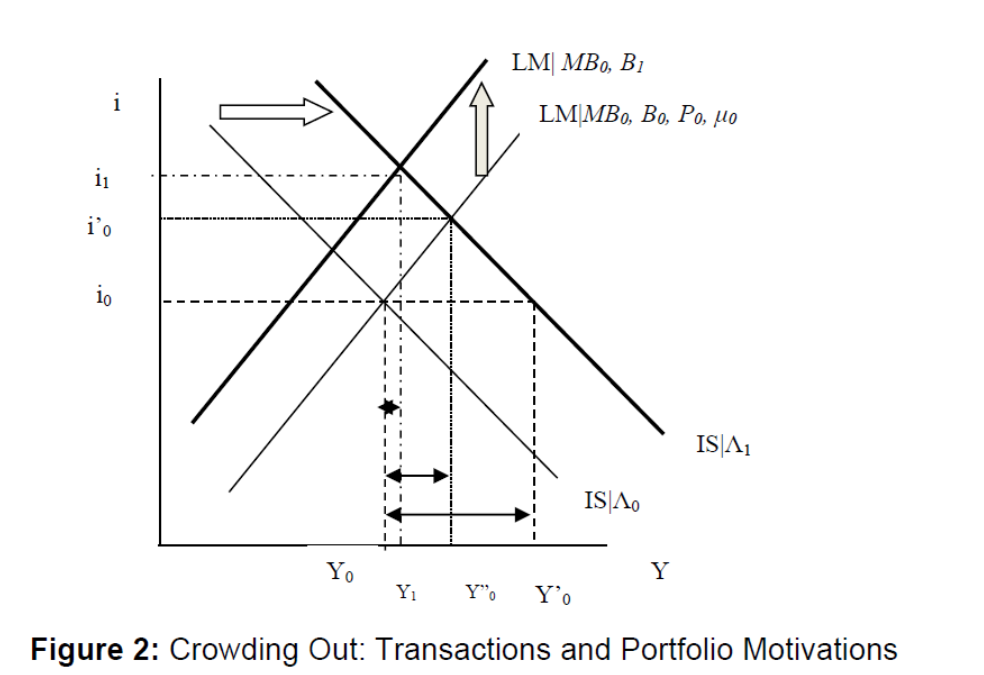
The debate over whether the real interest rate is determined by the demand and supply of all savings, or by the demand for money versus bonds due to liquidity preference and wealth demand, is a topic to be addressed before the Fall semester of teaching. The latter approach is often used to demonstrate portfolio crowding out resulting from government budget deficits. This can be illustrated using the IS-LM model.
In the loanable funds perspective, an increase in savings demand due to budget deficits results in higher interest rates. Both theories predict this outcome, yet they both offer valuable insights. However, the question remains as to which one is more accurate. If we consider only outside assets (which aligns with a non-Ricardian equivalence world), then the former determines the interest rate on government debt.
However, recent journalistic accounts have shown that corporate credit demand, especially from firms investing in AI capital expenditures, has also influenced the situation.
Hanno Lustig argues that US government debt has become more "risky," making government debt and high-quality corporate bonds closer substitutes. To support this claim, Lustig introduces the AAA Treasury gap. A graph of the Gilchrist-Zakrajsek spread, adjusted for maturity, is presented. Figure 1 shows the spread in percentage terms, sourced from the Federal Reserve Bank. The spread is relatively low, suggesting that the credit risk between US Treasurys and corporate bonds has decreased.
Written by urgent.news from Econbrowser's reporting — not their text. Machine-written — may contain errors; check the original before relying on it.