NASA’s Roman Telescope Enclosed in SpaceX Falcon Heavy Rocket Fairing
Teams finished preparing NASA’s Nancy Grace Roman Space Telescope for launch. On Aug. 21, the team encapsulated the observatory inside the SpaceX Falcon Heavy rocket’s fairing in the Payload Hazardous Servicing Facility at NASA’s Kennedy Space Center in Florida. The post NASA’s Roman Telescope Enclosed in SpaceX Falcon Heavy Rocket Fairing appeared first on NASA Science .
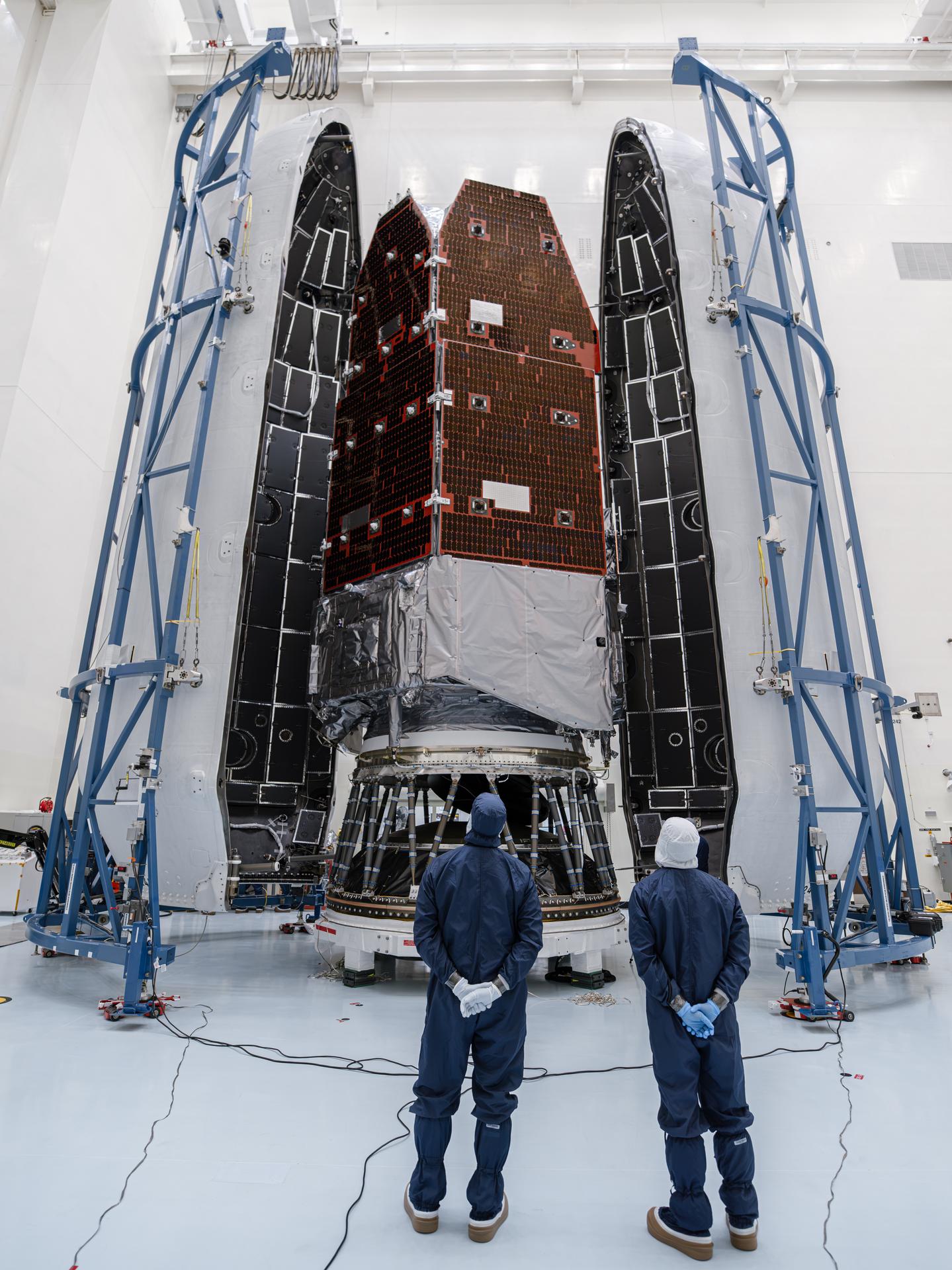
On August 21, 2026, NASA's Nancy Grace Roman Space Telescope was encased in the payload fairing of a SpaceX Falcon Heavy rocket at the Payload Hazardous Servicing Facility at Kennedy Space Center in Florida. The 43-foot-tall fairing, which safeguards the spacecraft from acoustic vibrations, aerodynamic pressure, and heating during launch, was mounted atop the Falcon Heavy.
Inside the fairing, Roman is kept in a controlled environment until it's ready to be attached to the rocket. The fairing and its ground support gear remain in place on the ground to protect Roman and enable its safe transport. As the Falcon Heavy ascends, the fairing separates a few minutes into the flight, allowing Roman to continue its journey towards the Sun-Earth Lagrange Point 2 (L2).
The two fairing halves will return to Earth and be recovered by SpaceX. NASA and SpaceX aim to launch Roman no earlier than 7:26 a.m. EDT on Sunday, August 30, 2026. Roman's mission is to study thousands of exoplanets and probe the mysteries of dark matter and dark energy, contributing to our understanding of the universe's accelerated expansion.
Written by urgent.news from NASA Science's reporting — not their text. Machine-written — may contain errors; check the original before relying on it.