NASA Starshade Would Enable Astronomers To Directly Image Rocky Exoworlds
Innovative NASA-funded orbital starshade could help capture first direct images from extrasolar earths.
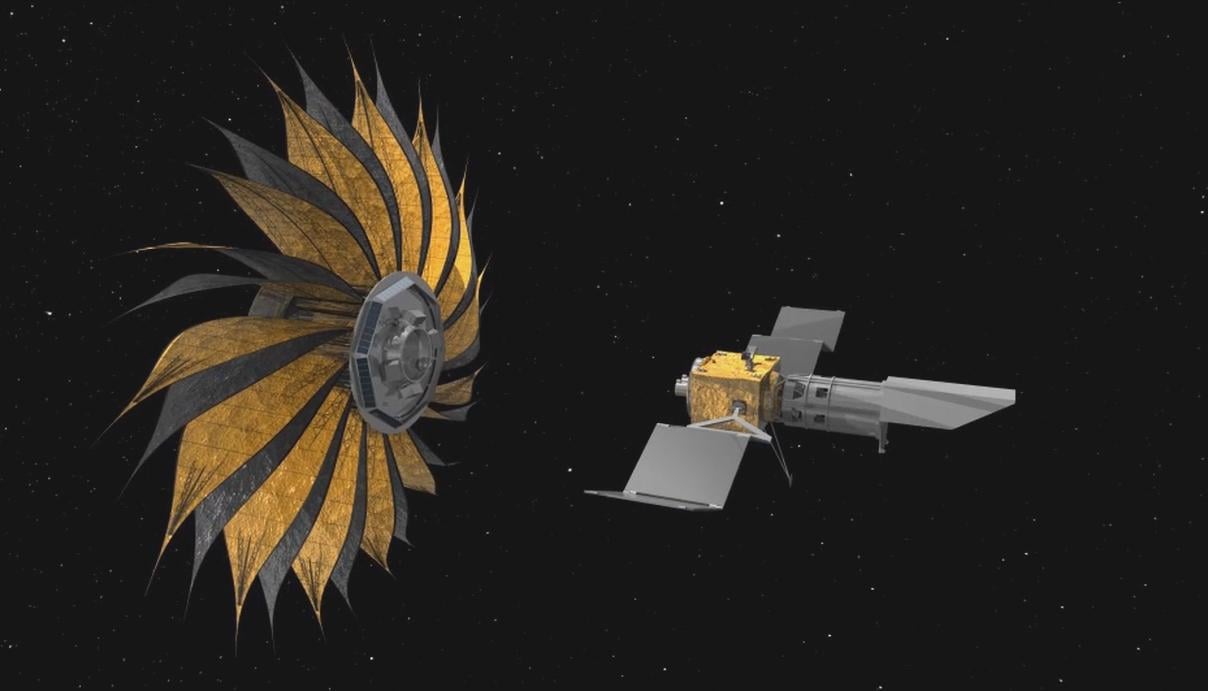
A NASA-led team is exploring a novel approach to directly imaging rocky exoplanets akin to Earth. Instead of conventional methods, the team proposes a hybrid telescope system, featuring an orbital starshade coupled with the next generation of large ground-based telescopes. This starshade would be stationed approximately 175,000km away in an elliptical orbit around Earth.
Its primary function is to block the light from the parent star, thereby enabling direct optical observations of nearby solar systems and Earth-sized rocky planets. This concept is encapsulated in the Hybrid Observatory for Earth-like Exoplanets (HOEE). The team has already submitted an application for Phase B NIAC (NASA Innovative Advanced Concepts) funding, with the hope of securing it by 2027.
Presently, state-of-the-art space instruments like NASA’s James Webb Space Telescope’s Near Infrared Camera and the planned Roman Space Telescope’s Coronagraph Instrument are incapable of directly observing Earth-like exoplanets. Vladimir Airapetian, a senior astrophysicist at NASA Goddard Space Flight Center and a member of the HOEE project team, emphasizes the necessity for an efficient and readily available solution.
The starshade, with its 48 petals, each 24.5-m long and a central disk with a 50-m diameter, aims to create an artificial eclipse, allowing ground-based telescopes to capture reflected light from the extrasolar planet. The starshade can be repositioned with micrometeoroid thrusters, powered by hot hydrogen gas, ensuring precise alignment within a six-meter radius.
Airapetian asserts that by employing the starshade, the HOEE can effectively suppress stellar glare before it reaches the Earth's atmosphere, thereby revealing the planet itself. This hybrid telescope's superior resolution would allow astronomers to view entire exoplanetary systems and separate planet images from other Earth-sized planets and the host star.
Moreover, it holds the potential to detect signs of life on these planets by identifying the spectral lines from red and green auroras, indicating the presence of nitrogen and oxygen in the atmospheres. Airapetian estimates the total cost at around a billion dollars. The final design of the starshade is expected to be an inflatable structure, keeping the total launch mass under 1,500 kg.
Airapetian concludes that what was once considered an impossible dream is now becoming a feasible reality, thanks to NASA funding.
Written by urgent.news from Universe Today's reporting — not their text. Machine-written — may contain errors; check the original before relying on it.