Urgent.News

What's breaking now, across thousands of outlets.

World

Government accused of 'logging by another name' in WA forests

South West locals say the WA government's support for ecological thinning is deeply concerning, and a number of scientists agree.
Government accused of 'logging by another name' in WA forests

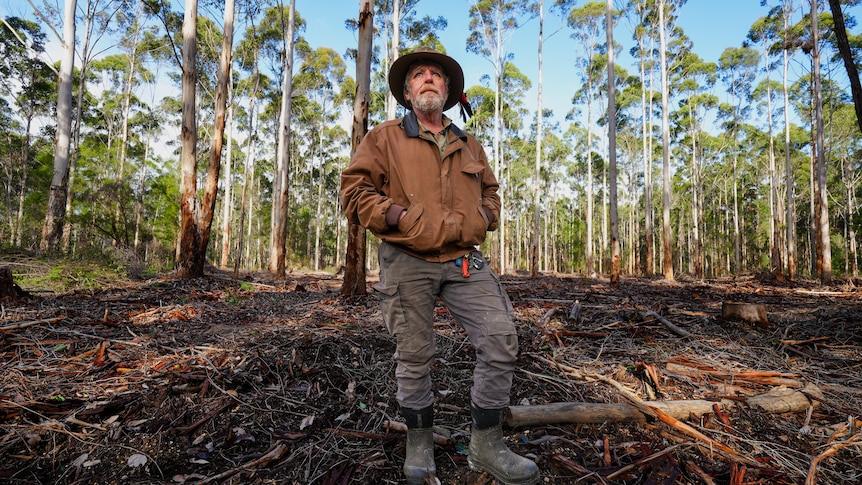
The Western Australian government is accused of conducting "logging by another name" through a process called ecological thinning. This involves removing smaller trees in native forests to allow the remaining larger trees to thrive. However, environmentalists and some scientists argue that this practice is essentially logging disguised as preservation efforts.

Ecological thinning aims to address drought-related stress on forests, which has increased due to a drying climate and historical logging practices. The Department of Biodiversity, Conservation and Attractions (DBCA) scientist Katinka Ruthrof reported that thinned forests show less water stress compared to unthinned areas. However, retired teacher and volunteer firefighter Jeff Thornton claims that the thinning process is similar to the past native logging, stating, "They don't care about the environment; they are just ripping up trees for money."

The DBCA emphasizes that they conduct independent inspections and assessments of thinned sites, managed by the Forest Products Commission. They also conduct ongoing research to evaluate the effectiveness of the thinning process. However, Professor David Lindenmayer from the Australian National University argues that there is limited scientific evidence to support the benefits of ecological thinning, stating, "I think there's a psyche that humans need to intervene in forests to somehow make them better."

Written by urgent.news from ABC News AU's reporting — not their text. Machine-written — may contain errors; check the original before relying on it.


Read the original at abc.net.au →

More in World

A massive collision 10 billion years ago turned our galaxy, the Milky Way, upside down. The galactic smash-up, which involved a large spiral galaxy, occurred 10 billion years ago when the universe was just 4.6 billion years old. Our galaxy, the Milky Way, is thought to have formed 13.6 billion years ago, not long after the Big Bang. The collision is believed to have involved a large spiral galaxy, which has been named the Gaia-Enceladus galaxy. The Milky Way was largely made up of stars that were born in the early universe, and it had a distinctive shape, with a large bulge of older stars at its centre and a disk of younger stars. But 10 billion years ago, the universe was just 4.6 billion years old, and the Milky Way had a very different structure. It had a large disk of stars, gas and dust, but not much of a bulge. The collision with the Gaia-Enceladus galaxy changed everything. The impact was so violent that it threw the Milky Way's stars, gas and dust into chaotic motion. The galaxy was turned 90 degrees on its side, and its stars, gas and dust were flung out into space. The stars that had made up the Milky Way's disk were scattered, some moving inward to join the bulge, while others were flung outward into the galaxy's halo. The collision is thought to have played a key role in creating the galaxy we see today. The distinctive bulge of older stars at the centre of the Milky Way is thought to have formed from the debris of the collision. The stars that make up the bulge are mostly older, redder and fainter than the stars in the disk. The study, published in the journal Nature, used data from the European Space Agency's Gaia spacecraft. Gaia has been orbiting the L2 Lagrange point, a gravitationally stable location about 1.5 million km from Earth, since 2013. The spacecraft has been mapping the positions and movements of 1.6 billion stars in the Milky Way. The study's lead author, Dr. Diederik Kruijssen, of the University of Heidelberg, said: "The Milky Way is a large spiral galaxy with a rather unusual shape." He said that the collision had "reshaped" the galaxy, creating the distinctive bulge of older stars. Dr. Kruijssen said that the study had provided "the most detailed picture yet of the Milky Way's evolution". The study's findings have provided new insights into the history of the Milky Way and the role that collisions have played in shaping the galaxy. The research has also raised new questions about the formation and evolution of galaxies. The study's co-author, Dr. Maria-Rosa Cioni, of the INAF Observatory in Italy, said: "The Gaia spacecraft has provided a wealth of data about the Milky Way." She said that the study had shown that the collision had "profoundly changed" the galaxy. The study's findings are an important reminder of the dynamic nature of galaxies and the role that collisions play in shaping their evolution.

More from Monday 24 August →