EBM-Papst: Amerikas Griff nach den deutschen Weltmarktführern
Deutsche Industriefirmen sind für US-Käufer zum lukrativen Übernahmeziel geworden. Eine exklusive Auswertung für das Handelsblatt zeigt das Ausmaß – und offenbart die Gründe für das wachsende Interesse.
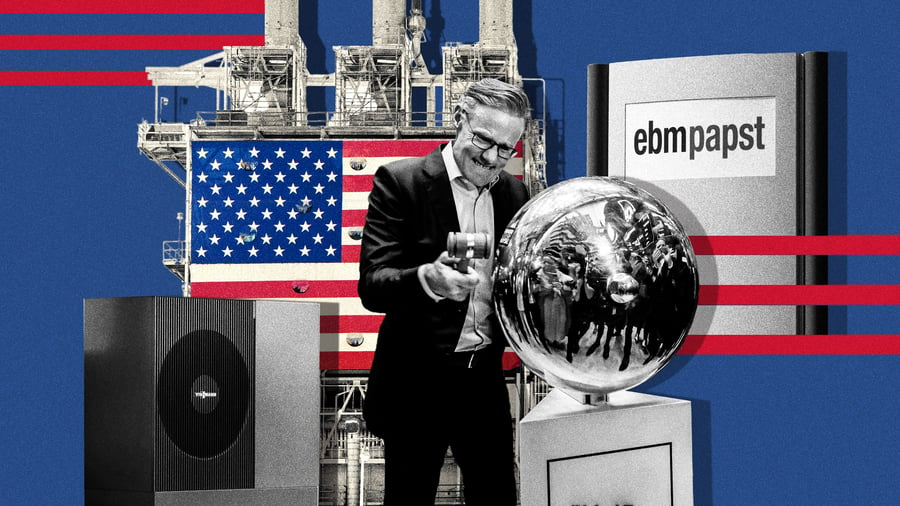
Larry Gies, a highly successful US corporate buyer and one of the most unknown, became a billionaire by buying modest industrial firms, consolidating them, and making them grow. He brought the climate technology company Madison Air to the stock market in April, one of the largest industry IPOs in the US for decades, raising 2.2 billion dollars.
Now, he continues his strategy with his largest coup yet: the acquisition of the German fan manufacturer EBM-Papst for 5.4 billion dollars. The hidden champion is from the small town of Mulfingen in Baden-Württemberg. What happens there has become a model. US corporations and financiers are increasingly chasing German industry champions.
An exclusive analysis for the Handelsblatt shows the scale of the deals. According to the Pitchbook data analysis for the Handelsblatt, the number of deals since 2022 has risen steadily. Last year, Pitchbook counted a total of 76 acquisitions and investments in German industrial and manufacturing companies with American involvement, the highest since the analysis began in 2022.
This year continues the high level: by August 19, there were already 47 transactions. The trend is even more evident in the money. Last year, the deals totaled around 29.5 billion dollars, nearly double 2022's figure. In the first seven and a half months of this year, another 23.9 billion dollars came in. A second analysis by the financial data provider Dealogic highlights how unusual the current level is: by mid-August, alone, US acquisitions of German industrial companies (without stakes) had totaled 16.5 billion dollars, almost as much as in the exceptional year of 2020, when it was 19.1 billion dollars.
The US capital markets had provided many US companies with favorable capital in recent years, explains Jacob Kirkegaard, an economist at the Peterson Institute for International Economics (PIIE) cited by the Handelsblatt. This gave them room to make acquisitions. At the same time, many domestic companies were overvalued, which is why US buyers are increasingly looking for targets abroad.
Germany is well-known to American investors, especially due to its outstanding reputation in manufacturing. A current driver, Kirkegaard says, is the industrial policy of the Donald Trump administration. "The new political focus on manufacturing capacity in the US plays a role in the current demand from investors for German manufacturers."
There is simply no noteworthy US manufacturing sector that could imitate and directly compete with German companies on global markets, he says. Little American competition Willi Westenberger of US investor Carlyle adds: "What particularly stands out in Germany is the wide range of highly specialized mid-sized companies, especially in the industrial and technology sectors."
Many of these are leaders in their respective markets. EBM-Papst's sale for 5.4 billion dollars is the latest in a series of large acquisitions. In 2023, the climate and heat pump division of the Hessian family company Viessmann was sold for around twelve billion euros to the US company Carrier. At the beginning of this year, Worthington Steel announced it would pay 2.4 billion dollars for the Düsseldorf steel dealer Klöckner.
In June, the US financier Bain Capital agreed to acquire a majority stake in the Augsburg ship and power engine builder Everllence, formerly MAN Energy Solutions. Volkswagen expects around 7.4 billion euros from the transaction and remains a 49 percent shareholder. In addition, smaller acquisitions add up, hardly drawing public attention.
In June 2025, the US conglomerate Dover bought two German mid-sized specialists: the Bremer measuring technology specialist Sikora, a hidden champion with around 450 employees, for 550 million euros. Also, the pump manufacturer Ipp from Bersenbrück, North Rhine-Westphalia, specializing in hygiene pumps for food, cosmetics, and pharmaceutical industries.
Just a few weeks ago, the Californian energy technology company Nextpower announced it would acquire the Zimmermann PV-Steel Group. The German manufacturer of steel frame modules for solar plants is worth around 380 million dollars to the Americans. Dan Shugar, founder of the billion-dollar company, calls the acquisition of the company from Eberhardzell-Oberessendorf "the next chapter" in its international expansion.
On the buying side, a peculiarity emerges: financial investors are bringing in most of the money. In 2025, according to Pitchbook's analysis, about 26 billion dollars came from private equity deals with US involvement, up from 7.6 billion dollars the previous year. By mid-August, alone, US acquisitions of German industrial companies (without stakes) had totaled 16.5 billion dollars, almost as much as in the exceptional year of 2020, when it was 19.1 billion dollars.
The US capital markets had provided many US companies with favorable capital in recent years, explains Jacob Kirkegaard, an economist at the Peterson Institute for International Economics (PIIE) cited by the Handelsblatt. This gave them room to make acquisitions. At the same time, many domestic companies were overvalued, which is why US buyers are increasingly looking for targets abroad.
Germany is well-known to American investors, especially due to its outstanding reputation in manufacturing. A current driver, Kirkegaard says, is the industrial policy of the Donald Trump administration. "The new political focus on manufacturing capacity in the US plays a role in the current demand from investors for German manufacturers."
There is simply no noteworthy US manufacturing sector that could imitate and directly compete with German companies on global markets, he says.
Written by urgent.news from Handelsblatt's reporting — not their text. Machine-written — may contain errors; check the original before relying on it.