Borderless pollution chokes Greater Jakarta as policy gaps persist
As urban air pollution continues to travel across Greater Jakarta, threatening public health and burdening the economy, authorities in the region are facing greater pressure to establish an integrated framework to tackle mounting borderless pollutants.
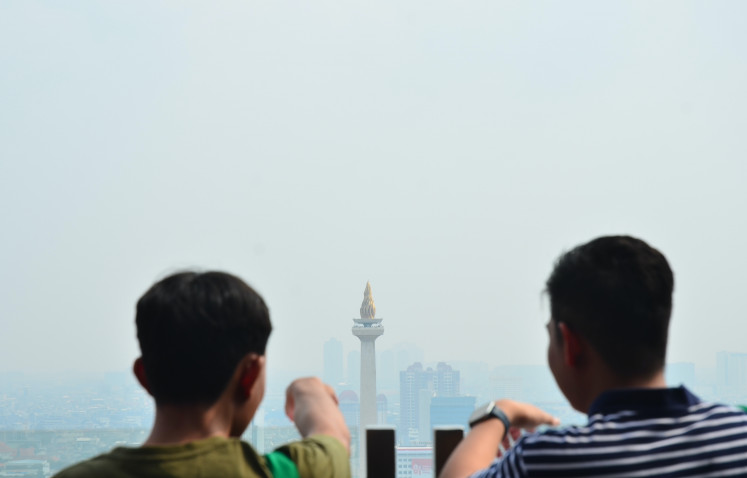
The Greater Jakarta region faces an increasing challenge as urban air pollution spreads across the area, impacting public health and the local economy. The pressure on authorities to create a unified framework to combat these borderless pollutants has intensified. Long plagued by severe smog, Greater Jakarta's 42 million residents are forced to breathe unhealthy air daily.
On a recent Sunday, the concentration of tiny toxic particles, known as PM2.5, reached an alarming 66 micrograms per cubic meter (µg/m3) in Jakarta, surpassing the World Health Organization's safety limit by a factor of 13.
A new study led by air quality management professor Puji Lestari from the Bandung Institute of Technology (ITB) reveals that a significant portion of the pollution in Jakarta originates from its suburban areas. The study found that pollutants from neighboring Tangerang in Banten, as well as Bogor, Depok, and Bekasi in West Java, account for approximately 38 percent of PM2.5 pollution in Jakarta.
Puji emphasized during a discussion hosted by the climate foundation ViriyaENB that "since pollution knows no borders, our response must move beyond administrative boundaries." She further urged for a single and unified air quality framework to manage pollution across Greater Jakarta.
Written by urgent.news from The Jakarta Post's reporting — not their text. Machine-written — may contain errors; check the original before relying on it.