Beyond China's humanoid robots, a quieter machine revolution is unfolding
There are more than two million robots working in China's factories - and they are scaling up fast.
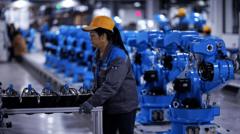
In a sprawling vocational school nestled on the outskirts of Hangzhou, a city transformed into a global tech hub, students and educators are embracing the future of manufacturing. Chen Tianyu, a 28-year-old teacher, watches as his 30 college pupils code, preparing them for a world where artificial intelligence and robotics dominate. The students' goal is to program industrial robots - not humanoids - to grab and move cylindrical objects.
The Hangzhou Technicians Institute, like many similar institutions across China, aims to produce a new generation of tech-savvy engineers. China is home to more than two million industrial robots, more than any other country, and the number is rapidly increasing. These machines are set to reshape the country, much like the nation's previous economic transformation.
China's commitment to automation is clear, with over half of the world's industrial robots now produced in the country. However, the impact of this sweeping change on China's human workforce remains uncertain. As the country faces a shrinking population and an aging workforce by 2035, experts predict that increased automation will help alleviate potential labor shortages in the manufacturing sector.
While robots perform simple repetitive tasks such as welding, painting, lifting, and assembling, there is still a long road ahead before China's workforce is ready to work alongside these machines. Pang Kai, a 31-year-old engineer at CRP Technology, a company building robotic arms for nine years, explains that their robots can currently only complete basic tasks.
However, their ultimate goal is to create robots that can think independently and eventually replace human workers. This ambitious vision is driven by China's need to fill the looming gap in the workforce due to an aging population.
Written by urgent.news from BBC News's reporting — not their text. Machine-written — may contain errors; check the original before relying on it.