Auto-Technik: So funktioniert der aktuell gängigste Elektromotor
Die geopolitisch umkämpften Seltenen Erden braucht man im E-Auto vor allem für den Elektromotor. Was der permanenterregte Synchronmotor leisten kann und was nicht.
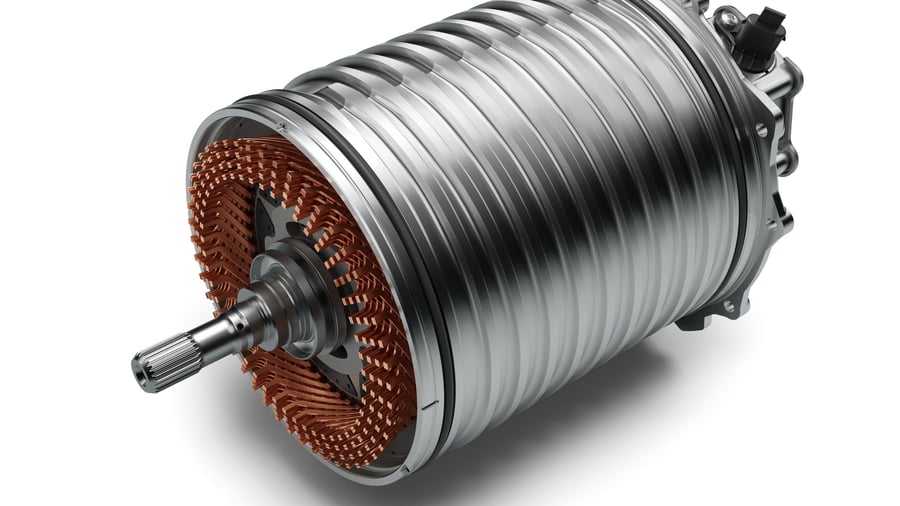
When the accelerator is pressed in an electric vehicle, it typically activates a permanent magnet synchronous motor, or PSM for short. Its strength lies in its combination of high efficiency, high power density, and compact design. However, there is a problem. The basic principle of the PSM is simple at first glance. In the stationary part of the motor, the stator, there are copper windings.
The vehicle's inverter converts the battery's direct current into three-phase alternating current. This creates a rotating magnetic field in the stator. The rotor, equipped with strong permanent magnets, aligns itself with this circulating magnetic field and rotates at the same speed, hence the term "synchronous." The torque can be precisely controlled through current strength and phase angle.
The key feature of the PSM is "permanent." The rotor does not need to generate its magnetic field electrically, eliminating excitation current and associated copper losses. This boosts efficiency and allows for a simple and compact rotor construction. The most common type is the IPM motor, where the magnets are embedded in the iron package instead of being on the rotor surface.
This design protects the magnets at high speeds and utilizes the reluctance effect: the rotor tries to adopt an energetically favorable position relative to the magnetic field due to its geometric shape, generating additional torque. Coolant is crucial for the PSM to function without compromises. At high speeds, the permanent magnets generate a strong counter voltage.
The power electronics must therefore partially compensate for the magnetic field through so-called field weakening. Additionally, the magnets must not overheat, as they could lose their magnetic strength permanently. Efficient cooling is therefore important. PSM drives can achieve very high efficiencies across a wide range of operating conditions relevant in everyday life.
For example, Bosch lists up to 93 percent for its complete E-axis with either permanent magnet synchronous or asynchronous motor. The technical rise of the PSM is closely linked to advances in permanent magnets and power electronics. Neodymium-iron-boron magnets, independently developed by General Motors and Sumitomo in the early 1980s, provided the high magnetic energy density that allowed for smaller and more powerful motors.
With powerful transistors, digital motor controllers, and increasingly better magnet materials, the technology became attractive for hybrid and electric vehicles. Today, the internally mounted permanent magnet machine is the dominant design for electric traction motors, especially in volume models, more prevalent than externally excited motors and asynchronous motors.
The main weakness of the PSM lies not in operation but in the raw material chain. High-performance magnets often consist of neodymium-iron-boron and may contain rare earths that improve their temperature resistance. The extraction and processing of these raw materials are environmentally problematic and geographically concentrated.
In fact, China currently has a virtual monopoly. Manufacturers are therefore trying to reduce the required magnet amount or largely dispense with particularly critical rare earths. Advances in cooling and motor design help with this. The PSM is by no means an alternative-free solution. Asynchronous motors (ASM) do not use permanent magnets but must generate the magnetic field electrically in the rotor, making them less efficient.
The same applies to externally excited synchronous motors, which generate the rotor field with coils. Companies like ZF are developing variants where the required current is transferred to the rotor without contact. Even synchronous and switched reluctance motors dispense with rare magnet materials but face other challenges such as power density, noise, and control.
The search for the ideal electric motor is therefore not over: In the future, instead of a single design winning out, a competition may emerge to balance efficiency, raw material demand, cost, and performance for each vehicle type.
Written by urgent.news from Handelsblatt's reporting — not their text. Machine-written — may contain errors; check the original before relying on it.