Amin Mughal taught Pakistan’s Left and media to disagree without falling apart
Amin Mughal, who died in London on August 12, 2026, spent a lifetime translating between Pakistan’s revolutionaries, dissidents and journalists so their fractured Left could at least understand itself. In 1981, the state arrested three editors at once: Mazhar Ali Khan, I.A. Rehman and Amin Mughal, all picked up in the same sweep. The weekly they ran, Viewpoint , did not miss an issue. Zafar Iqbal…
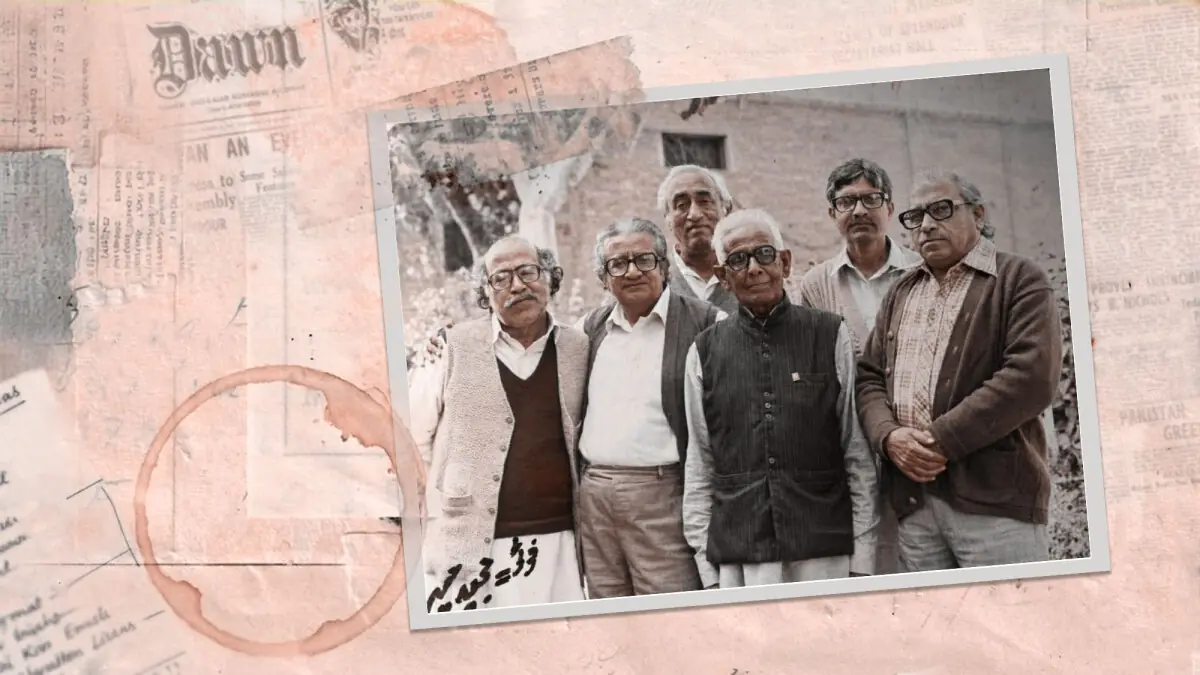
Amin Mughal, who passed away in London on August 12, 2026, devoted his life to bridging the gaps between Pakistan's dissidents, journalists, and revolutionaries, allowing them to comprehend each other. In 1981, the government arrested three editors, Mazhar Ali Khan, I.A. Rehman, and Amin Mughal, all apprehended together. The magazine they published, Viewpoint, never missed an issue despite the trio being in prison.
Zafar Iqbal Mirza, known as ZIM, kept the paper afloat from within while the editors languished in jail, demonstrating loyalty that defines this narrative and speaks volumes about Amin Mughal's character. His legacy is not limited to his accomplishments, such as teaching, imprisonment, journalism, and his time abroad; it transcends the surface to reveal the essence of his significance.
This account delves into his life posthumously, highlighting the qualities that made him indispensable. The accompanying image depicts six men standing in a circle. From left to right: ZIM, Shafqat Tanvir Mirza, Dada Ameer Hyder, and I.A. Rehman; behind them, Major Ishaq Muhammad and Amin Mughal. Dr. Ikram Ul Haq captured this photograph, revealing the unity of a moral republic that Pakistan's state has yet to acknowledge.
The photograph's significance lies not in the agreement among the men but in the diversity of their roles within the resistance. Mughal, standing in the second row, was not the central figure, yet he was integral to the intellectual connections illustrated in the photograph. Mughal's life was characterized by a pattern of showing up, listening, staying connected, and never seeking the limelight.
His contributions were not tangible works but a series of unbreakable connections that would not have existed otherwise. He united the organized Left, led by Dada Ameer Hyder and Major Ishaq, with the democratic journalism of ZIM and I.A. Rehman, and the cultural resistance of Shafqat Tanvir Mirza, eventually reaching younger journalists like himself who were unaware of the invaluable legacy they inherited.
Mughal worked at Viewpoint between 1979 and 1984, where he gained his most profound education, blurring the lines between editing, teaching, political analysis, literature, and disagreement—all while maintaining a harmonious balance. Born as a coal-boy on a ship, Dada Ameer Hyder had lived globalisation firsthand, experiencing labor, empire, and racial hierarchies across continents.
He organized workers across borders long before the term "globalisation" became popular. His biography was one of direct, personal encounters with global issues before they gained international recognition. The author met Dada Ameer Hyder at Viewpoint, where his authenticity shone through his survival, not his claims. His authority stemmed from his experiences rather than his assertions.
Historians often overlooked him, as independence movements frequently absorb elite leaders. A coal-boy questioning the tangible benefits of independence to other workers posed a unique challenge, one that states solved by ignoring. Major Ishaq was a soldier who extended beyond the boundaries of his uniform, drawing the state's attention and multiple imprisonments.
Despite his tumultuous history with the state, he remained committed to asking critical questions about independence and its true impact on the populace. He organized peasants and workers, viewing revolution as a gradual, laborious process rather than a sudden upheaval. His life defied the simplistic categorizations of dissidents, being simultaneously a soldier and a critic, a patriot and a traitor.
Shafqat Tanvir Mirza fought for language, using his expertise in journalism, trade unionism, history, and scholarship to restore the status of Punjabi, a language marginalized by the powers that be. His scholarly work on Punjabi literature and Sufi poets gave linguistic weight to a language spoken by millions but disregarded by the establishment.
His efforts led to imprisonment and setbacks, yet he never let his passion for language wane or his openness to dialogue with those who disagreed with him. Former editor I.A. Rehman took these principles and founded an institution dedicated to human rights. His unwavering commitment to justice, even when it meant enduring bitterness, set a standard few manage to emulate.
He spoke softly, listened attentively, and never moved from his path, turning the struggle for human rights into a long-term commitment rather than an act of sacrifice. His enduring testament is the acknowledgment that decades-long battles against injustice do not need to turn into bitterness. His advice, "The struggle for human rights is a marathon, not a sprint," resonates more profoundly in a society obsessed with immediate outrage and despair, far surpassing the impact of most policy papers.
Mughal's distinctiveness lay in his ability to navigate between these diverse worlds without diluting their unique identities. He bridged the gap between Dada Ameer Hyder and Major Ishaq, connected ZIM and I.A. Rehman, and linked Shafqat Tanvir Mirza to emerging journalists, imparting a profound understanding that went beyond traditional roles.
Written by urgent.news from Dawn's reporting — not their text. Machine-written — may contain errors; check the original before relying on it.