Why IAF still needs Sukhoi in the age of Tejas and Rafale
The Su-30MKI remains a vital pillar of India's combat fleet. This heavy fighter provides essential long-range strike and air superiority capabilities. Newer aircraft like Rafale and Tejas fulfill different roles within the air force. Modernization programs will ensure the Su-30MKI's relevance for decades to come. This strategy balances numbers, range, and advanced technology for national defense.
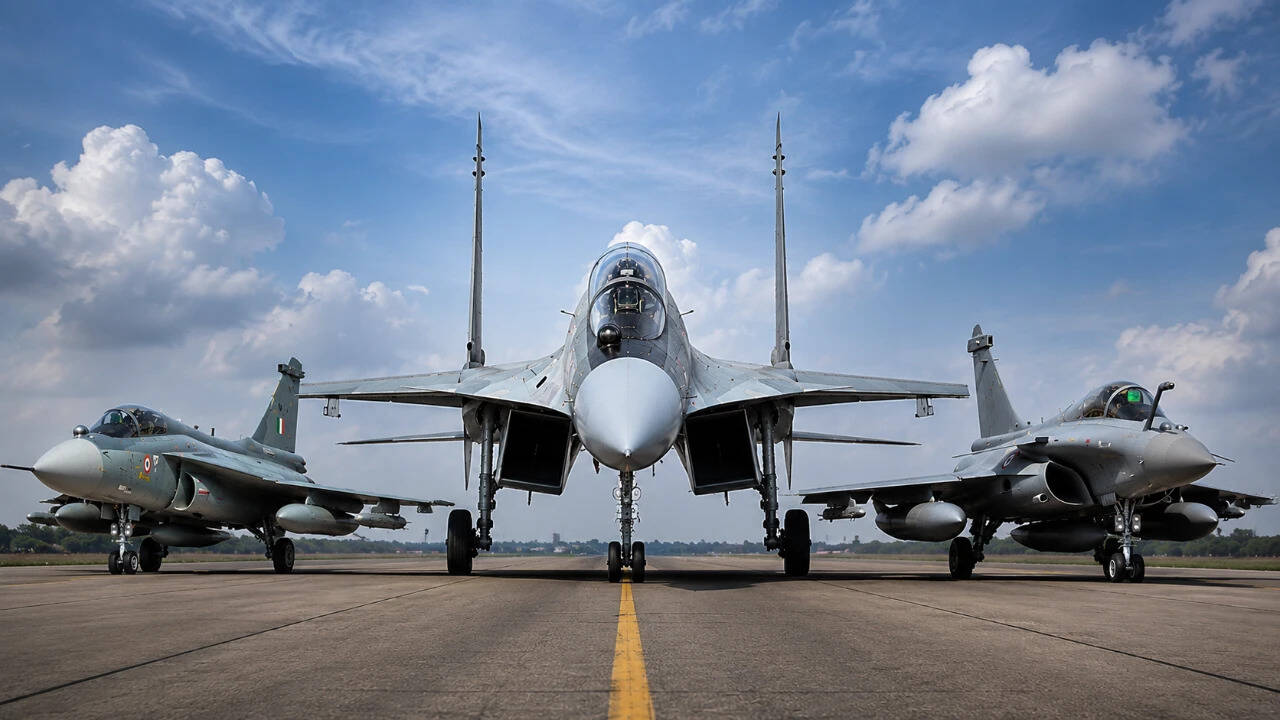
On June 11, 1997, India's Indian Air Force (IAF) welcomed its first eight Su-30K fighters into No. 24 Squadron, marking the beginning of a significant partnership with Russia. This aircraft evolved into the Su-30MKI, which now serves as the backbone of India's fighter fleet. The IAF currently operates around 260 Su-30MKI fighters, with more ordered to maintain fleet strength.
The decision to acquire the Su-30 was influenced by the changing strategic environment around India. Following Pakistan's acquisition of F-16 fighters during the 1980s and India's subsequent inducting of the French Mirage 2000 in 1985 and the Soviet MiG-29 in 1987, concerns arose about China's rapid military modernisation. In response, India sought a fighter capable of long-range missions, carrying a heavy weapon load, and maintaining flight time for extended periods.
The Su-30MKI was selected due to its ability to cover long distances, carry a large weapons load, and remain airborne for extended missions. It offers air-superiority and strike capabilities, complementing the lighter fighters in the IAF's inventory. The aircraft is equipped with advanced sensors, electronic warfare systems, and networked combat capabilities, providing a balance to the Tejas and Rafale aircraft.
Srijan Pal Singh, a former Advisor for Policy and Technology to Dr APJ Abdul Kalam and the CEO of Homi Lab, explains that the Su-30MKI occupies a distinct position in the IAF's fighter fleet due to its range, payload, and endurance. Its ability to carry heavy weapons, including the BrahMos missile, and remain airborne for extended periods makes it an essential asset for long-range air superiority, deep-strike, and maritime missions. This role is distinct from that of the Tejas and Rafale, which focus on different capabilities.
Written by urgent.news from Times of India's reporting — not their text. Machine-written — may contain errors; check the original before relying on it.