Object-Oriented Programming for Web Developers: Lessons From an Old Flash Game
An old ActionScript game shows how inheritance, composition, state machines, and data-driven design can still improve modern web application architecture.
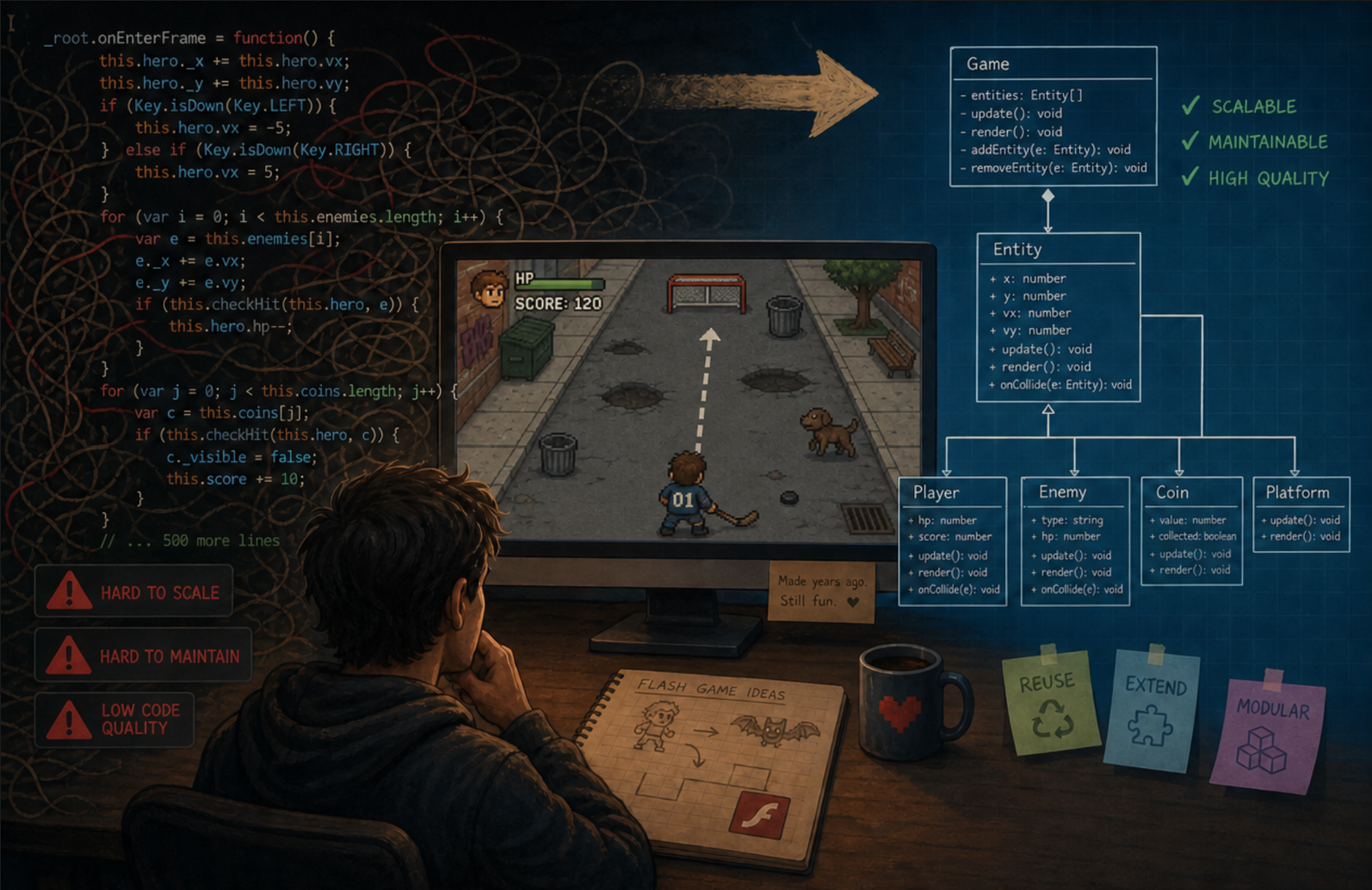
The Object-Oriented Programming (OOP) principles are crucial for building scalable and maintainable code, but web developers often lack proper education on these concepts. In this story, the author shares their experience of teaching OOP principles using a Flash game called SharpShooter. The game was built in ActionScript 3 using the Starling framework for GPU-accelerated rendering.
The game's architecture features a class hierarchy that starts with SpriteBase, which extends Starling’s Sprite class. SpriteBase takes care of common tasks such as loading sprite sheets from external image files, parsing XML definitions, managing textures, handling animations, and handling hit areas. This design allows for code reuse and easier maintenance, as changes made to the base class automatically propagate to all inheriting classes.
The author emphasizes the importance of inheritance, composition, encapsulation, and polymorphism in OOP. Inheritance allows for a single source of truth, reducing code duplication and making updates easier. Composition offers a "plug-and-play" approach to behaviour, enabling new functionality to be added by simply modifying data files instead of writing new code.
Encapsulation ensures that objects manage their own state and expose only what is necessary to other objects, simplifying debugging and reducing the risk of unintended side effects. Finally, polymorphism allows for interchangeable objects, enabling code to work with a base interface without needing to know the specific implementation.
In the case of SharpShooter, these OOP principles allowed for a highly modular and extensible codebase. New graphics, animations, levels, and behaviours could be added without modifying existing logic, simply by updating external files. This approach greatly simplified the process of reskinning and rebranding the game for different promotions, without requiring any code changes or recompilation.
In conclusion, the author argues that web developers need to learn the foundational OOP principles that they were not taught in traditional web development education. By applying these principles in their work, web developers can create more maintainable, scalable, and flexible codebases, ultimately leading to better software development practices and more efficient development processes.
Written by urgent.news from HackerNoon's reporting — not their text. Machine-written — may contain errors; check the original before relying on it.