Chartbook 469: The risk of unwind - The US Treasury market in the era of the hedge fund-profit dollar.
The interest rate set by bond markets around the world, are going up.
The interest rates set by bond markets are on the rise as tens of trillions of dollars in fixed-interest debt trade at lower prices, causing yields to increase. The most significant market affected by this is the vast US Treasury market. In the summer of 2026, the focus shifts to China's shock, specifically its massive trade surplus and the US's significant deficit. This era, characterized by "twin" US deficits (both government budget and current account), is considerably different from the past.
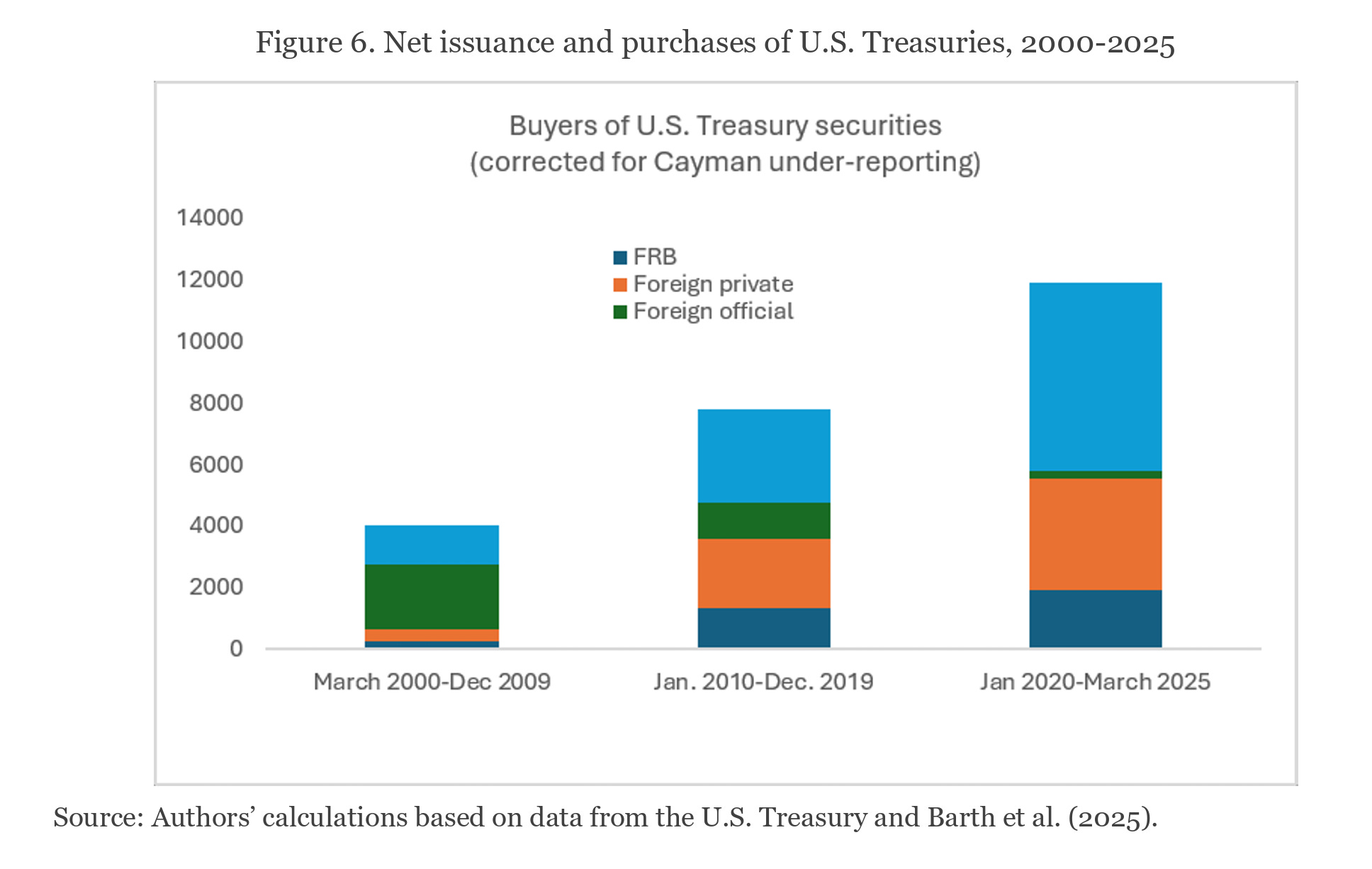
Traditionally, these twin deficits were interconnected through financing mechanisms. China's trade surpluses with the US were reinvested by official reserve managers in US Treasury bonds, a relationship referred to as "Bretton Woods 2.0" recycling. However, this connection has become less straightforward. Anusha Chari and Gian Maria Milesi-Ferretti of Brookings explain that the classic era of reserve accumulation between 2000 and 2009 saw a substantial portion of net US Treasury issuance acquired by foreign official reserve holdings. Since the 2008-2009 crisis, the twin deficits model has evolved into a new regime.
During the 2010s, despite post-crisis deficits piling up and US Treasury issuance remaining rapid, foreign official reserve accumulation gradually diminished. Foreign private investors and domestic private investors started to absorb the new issuance of Treasuries. Tracy Alloway's graph illustrates this shift, with the dark turquoise line (representing official foreign reserves) peaking around 2008-2009 at over 40 percent and gradually declining.
The lighter blue line, representing foreign private holdings, overtakes official foreign holdings, while domestic private investors become the dominant buyers. Even though China maintains substantial trade surpluses with the US, the overall dynamics of the US Treasury market have shifted significantly.
Written by urgent.news from Chartbook's reporting — not their text. Machine-written — may contain errors; check the original before relying on it.