Astronomers Use Rare Ultra-Magnetic Star to Crack a Quantum Mystery
An international team observed a magnetar known as 1E 1547.0–5408 using NASA’s Imaging X-ray Polarimetry Explorer (IXPE), leading to what could be the first detection of vacuum birefringence taking place in the magnetar’s ultra-strong magnetic field. These findings could potentially resolve a long-standing mystery quantum mechanics.
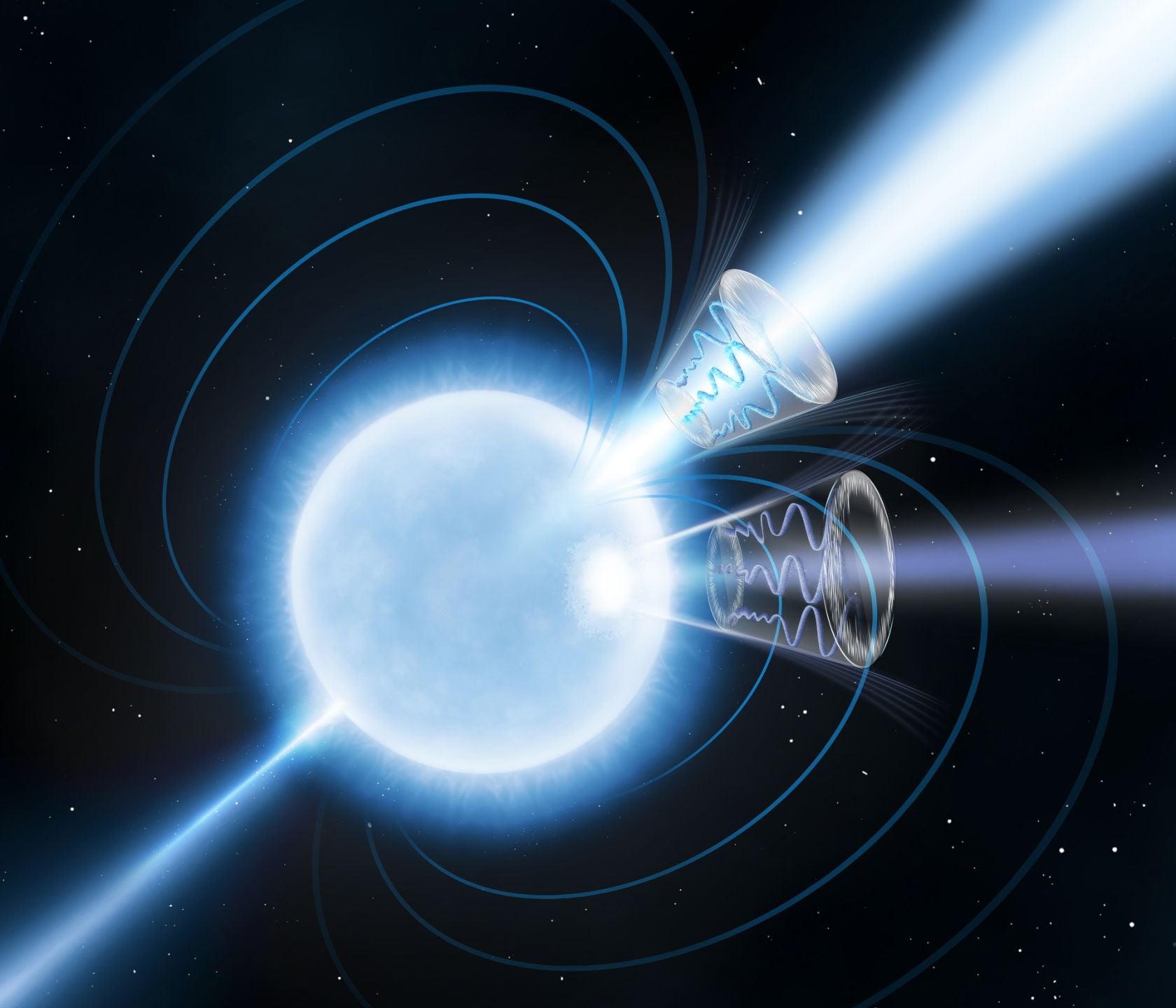
In a groundbreaking discovery, astronomers have potentially uncovered the first evidence of a quantum effect known as vacuum birefringence. This principle, first theorized by Werner Heisenberg nearly nine decades ago, posits that even empty space can influence the behavior of light. Despite decades of research and experimentation, this effect remained unconfirmed until now.
However, a team of international scientists may have finally cracked this quantum mystery using the unique properties of a magnetar, a rare type of neutron star with the strongest magnetic fields in the Universe.
The study, led by Rachael E. Stewart from George Washington University, involved researchers from various institutions and universities worldwide. They utilized the properties of magnetar 1E 1547.0–5408 (1E1547) to detect what could be the first evidence of vacuum birefringence. The findings, published in Nature, could pave the way for new insights into the exploration of the quantum realm.
Magnetar 1E1547 exhibited magnetic and rotational axes that were nearly aligned, making it almost pole-on visible. This specific magnetic and viewing geometry rendered it ideal for detecting vacuum birefringence. The team observed X-rays produced by the magnetar, which had extremely high polarization, and found that these X-rays' polarization direction was locked to 1E 1547's magnetic field, similar to its radio waves.
Dr. Marcus Lower, an Australian Research Council DECRA Fellow at the Center for Astrophysics and Supercomputing at Swinburne University of Technology, explained that detecting vacuum birefringence requires a magnetic field over 100 million times stronger than any made on Earth. Thankfully, nature provided them with magnetars, which are the perfect cosmic laboratories to search for this effect.
The team's findings indicate that Heisenberg's virtual particles become aligned with the magnetic field's direction due to its strength. By tracking the direction of radio waves and X-rays oscillation as the magnetar rotates, they discovered that the alignment of 1E1547's magnetic and rotational poles was ideal for detecting vacuum birefringence.
With further data and improved computer simulations, the team is optimistic that they may finally complete Heisenberg's quest nearly 90 years in the making. If confirmed, this discovery will provide valuable insights into the workings of quantum physics in one of the universe's most extreme environments.
Written by urgent.news from Universe Today's reporting — not their text. Machine-written — may contain errors; check the original before relying on it.