Gen Alpha protests mirror government report: Big gaps in school education
Issues Neither Unique To Any Region, Nor Universal
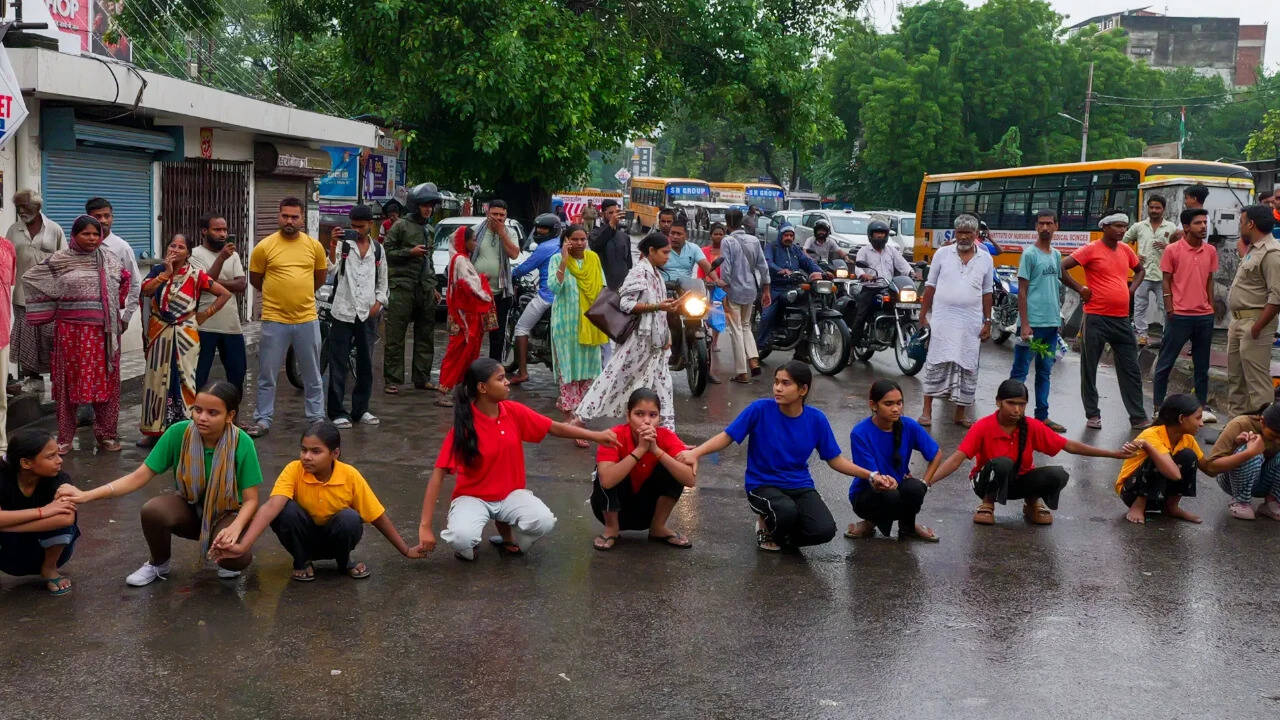
In a recent wave of student protests across India, schoolchildren are demanding basic improvements to their educational environment, such as accessible roads, functioning toilets, and playgrounds. These grievances, while localized, highlight systemic issues that affect a significant portion of India's school system.
In locations like Hamirpur, Lucknow, and Jaipur, children have marched to gather attention to their concerns. Hamirpur reported 300 students marching six kilometers to demand a usable road; Lucknow saw 250 girls protest for more teachers and basic facilities; and Jaipur witnessed students with disabilities advocating for improved sanitation and classrooms.
The issues are not uniform across regions. In Jharkhand, there are 36 pupils per teacher; West Bengal has internet access in only 19.7% of schools; and Meghalaya provides toilets for children with special needs in just 6.3% of schools. Conversely, Karnataka has over 8,042 single-teacher schools, comprising 10.8% of its total; and while Kerala boasts internet in 92.6% of schools and functional computers in 99.1%, there are 68 schools with no enrolled students.
The discrepancy in resources is evident between state and private institutions. State governments oversee 68.4% of India's schools, with private unaided management accounting for 23.3%. Of the 14,66,682 schools in the country, 10,03,051 are state-run, 2,194 are central government schools, 3,41,689 are private unaided recognized schools, and 79,261 are government-aided.
According to the Unified District Information System for Education Plus NE-26 report, there are 24.7 crore students enrolled in 1,32,682 schools, with a pupil-teacher ratio of 24. Infrastructure coverage varies, with 67.4% of schools having internet, 63.1% with functional computers, and digital libraries present in 7.1% of schools. Playground facilities cover 81.9% of schools. For children with special needs, friendly toilets are available in 40.1% of schools, ramps in 79.7%, and ramps with handrails in 58.2%.
A notable disparity exists in teacher deployment. The report indicates over 29 lakh students in 1,00,843 single-teacher schools, alongside 20,667 teachers in 5,663 schools with no pupils. Functional toilets for girls are present in 95.3% of state government schools and 96.9% of private unaided schools, but the situation is less favorable for children with special needs, where only 35.6% of state government schools and 44.7% of private schools have such amenities.
Digital libraries are found in 5.6% of state government schools and 11.2% of private institutions, with private schools leading in internet connectivity (79.2% vs. 63.1% in government schools) and functional computers (74% vs. 59.4%). However, government schools outperform private ones in accessibility features, such as ramps (88.2% vs. 60.4%) and ramps with handrails (66.9% vs. 36.8%).
Written by urgent.news from Times of India's reporting — not their text. Machine-written — may contain errors; check the original before relying on it.