De estrecho a estrecho, es el turno de Europa
La UE debería tomar nota de los planteamientos del seguridad del acuerdo militar entre Turquía, Arabia Saudí y Pakistán
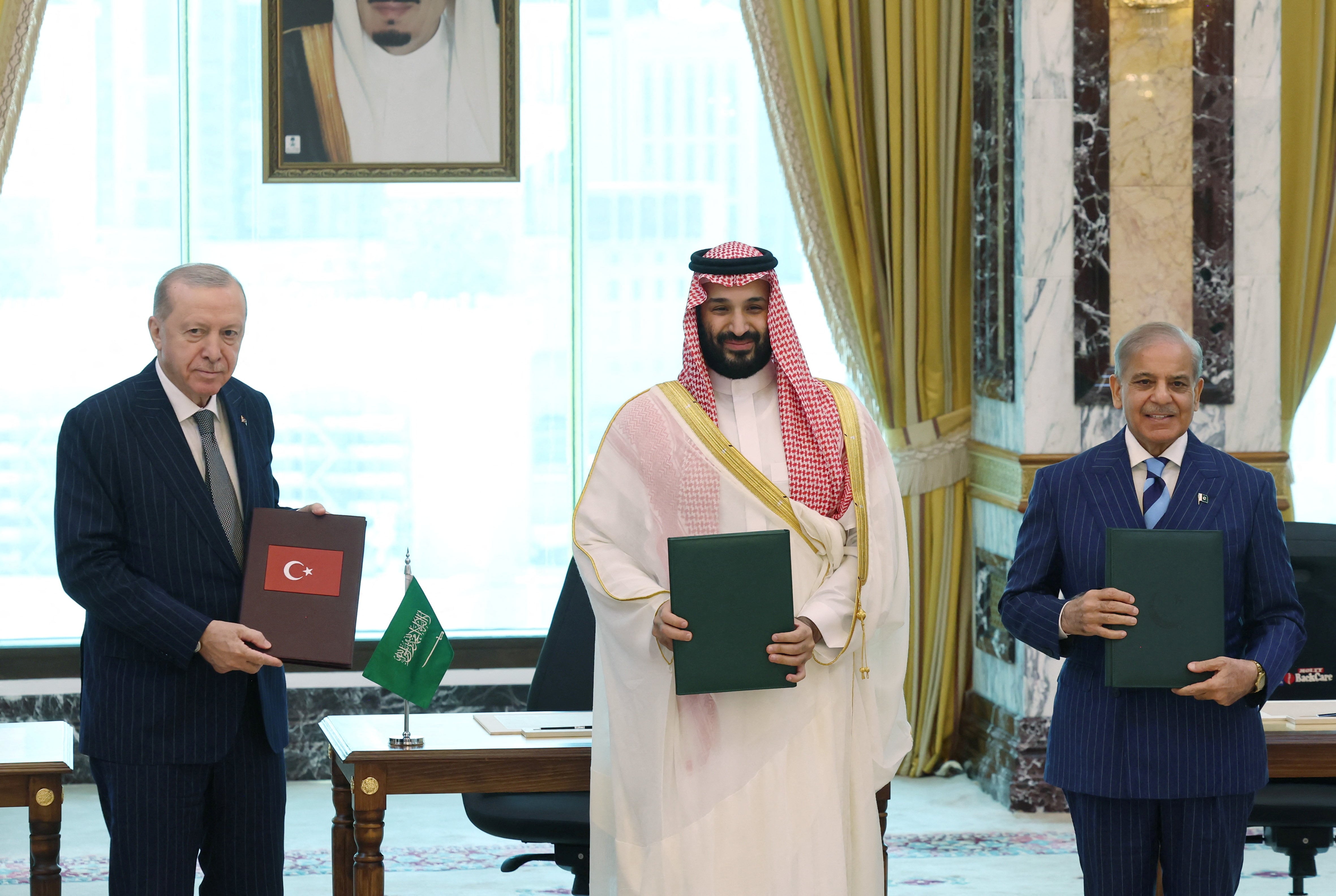
In an unexpected move, the leaders of three Sunni countries – Turkey, Saudi Arabia, and Pakistan – have signed the Joint Defense Agreement of Mecca, declaring that "any armed attack against any of the three States will be considered an attack against all of them." This agreement reveals a desire for deterrence that will be tested over time and signals the emergence of deterrent aspirations aimed at Tehran.
Each signing state contributes something unique: Saudi Arabia brings financial resources and energy influence; Turkey, the second-largest NATO army, arms industry and drone capabilities; Pakistan, the only Muslim country with a nuclear arsenal, has field experience and a consolidated military. While tensions simmer beneath this complex alliance, questions arise: would Pakistan use its nuclear arsenal against Iran if a missile landed on Saudi soil?
Would Riyadh or Ankara risk a border skirmish with India and Pakistan? These speculations aside, the pact formalizes a trilateral framework that will promote cooperation in defense research, intelligence sharing, and maritime surveillance. For now, its relevance lies in the combined defensive capabilities that shift the balance of power for countries that may be directly or indirectly affected.
Donald Trump has endorsed this creation – "an important, great, and brave first step," he declared. From a calming perspective, it does not represent a rejection or distancing from the United States, but aligns with the White House's goal of partners and allies increasing their defense burden, allowing Washington to "re-calibrate its military role in the region and move from guarantor of security to integrator."
This desire extends to Europe and Asia, as seen with South Korea. This integration, if realized, would not necessarily follow the path envisioned before October 7, 2023 – a Near East centered around the IMEC (India-Europe Economic Corridor project passing through the Middle East, with eight countries and the EU participating) and the Abraham Agreements, aimed at normalizing relations with Israel – but something more uncertain.
The Hamas attack unleashed change forces nobody had anticipated, which, three years later, are still far from being exhausted. The new alignment could shape a bifurcated region into two blocs, each with its own ramifications. Simple and old logic dictates: if the signatories of La Meca gain influence, it will be at the expense of their rivals, and it is not surprising that they seek ways to counteract this by tightening ties among themselves.
On one side stand Saudi Arabia, Turkey, and Pakistan; on the other, an as-yet informal axis featuring Israel, India, and to a lesser extent, Greece, Cyprus, and the United Arab Emirates. Let us start with Israel, which Erdogan now frequently labels as an "enemy," weaving defense cooperation networks in two directions: towards Greece and Cyprus, Turkey's historical rivals and less inclined to view Turkey's growing military presence in the Eastern Mediterranean favorably; and towards India, a rival of Pakistan, observing with hesitation as La Meca could strengthen Islamabad, closely linked to Turkey in the Kashmir issue and supplying arms.
Israel has also strengthened security ties with the UAE, and normalized relations via the Abraham Accords. Saudi Arabia occupies the geographical center of the IMEC. Despite its dependence on the United States – sealed by the nuclear agreement between the two countries – Riyadh seems reluctant to join the Abraham Accords until a Palestinian state exists, a condition that has put the corridor's design itself in dispute: a new route proposed would carry a railway from Saudi Arabia to Europe, passing through Jordan, Syria, and Turkey, bypassing Israel entirely.
Instability caused by the US-Israel war against Iran has led regional middle powers to take the initiative and add a layer of security. The signatories of La Meca share the interest in protecting the Strait of Hormuz, but also Bab el-Mandeb in the Red Sea, highlighting the strategic importance of these maritime straits and passages.
The European Union, a part of the IMEC, should take note. Europe has its own strait, Gibraltar, a liminal border between two continents and a chokepoint connecting the Atlantic to the Mediterranean. Its importance is not less than Hormuz or Bab el-Mandeb: control determines, in the final analysis, a European capacity to project or suffer influence in its own southern flank.
Hence, the Ceuta crisis, and what concerns Morocco more broadly, extends beyond a migration and border issue, and ventures into the realm of strategic security: whoever controls Gibraltar's access points also conditions the margin of maneuver of the European Union itself.
Written by urgent.news from El Pais's reporting — not their text. Machine-written — may contain errors; check the original before relying on it.