California’s Drought Irreversibly Damaged Sacramento Valley Aquifers
Satellite data have revealed an abrupt drop in aquifers’ ability to recharge after the 2020–2022 drought. More real-time monitoring could spot the issue before it arises again.
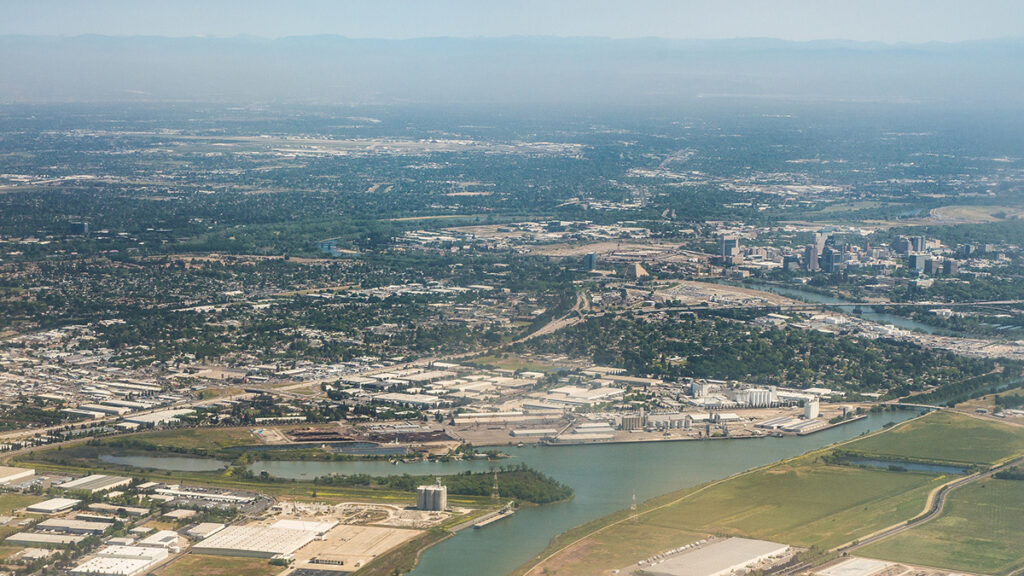
In 2020 to 2022, California experienced one of its driest periods on record, largely due to human-induced climate change. A new study published in the Proceedings of the National Academy of Sciences of the United States of America has found that the drought and excessive groundwater extraction caused irreparable damage to some aquifers in the Sacramento Valley.
This study is the first to utilize high-resolution satellite data to capture this kind of aquifer collapse, providing evidence for increased protection measures for the Sacramento Valley's aquifers.
Geophysicist Stacy Larochelle of the University of California, Los Angeles, discovered the impact on groundwater and aquifers while analyzing regional Global Navigation Satellite System (GNSS) data. She noticed a regular seasonal pattern in the depletion and refilling of aquifers from 2016 to 2020. However, she observed a sudden change in 2021 when parts of some aquifers began to sink.
Further analysis using interferometric synthetic aperture radar (InSAR) data, GNSS data, and groundwater monitoring wells confirmed the findings.
When groundwater is pumped out of an aquifer, the empty space left behind causes the aquifer to shrink. If this process is sudden and excessive, the aquifer's sediment may deform irreversibly, losing its ability to recharge and store water in the future. During the 2020-2022 drought, some areas of the Sacramento Valley experienced subsidence rates up to 30 centimeters per year, which could damage the aquifer's infrastructure.
Post-drought, the ground has not fully recovered, and some parts of the aquifers may not recover at all, leading to reduced water storage capacity and potential flood risks.
Protecting the Sacramento Valley's aquifers is crucial, as many basins in the San Joaquin Valley, adjacent to the Sacramento, were designated as "critically overdrafted" under California's Sustainable Groundwater Management Act (SGMA) in 2014. Researchers suggest reconsidering the Sacramento Valley's SGMA classification to ensure more cautious groundwater extraction.
The study's methods also offer a real-time tracking system using satellite data to monitor groundwater pumping and potentially alert communities to overpumping before irreversible damage occurs.
Written by urgent.news from Eos's reporting — not their text. Machine-written — may contain errors; check the original before relying on it.