Urgent.News

What's breaking now, across thousands of outlets.

Editions

Business

Abschreckung: Bundeswehr unterstützt Polen beim Schutz der Nato-Ostgrenze

Deutsche und polnische Soldaten sichern gemeinsam Polens Ostgrenze nahe der russischen Enklave Kaliningrad. Was der Bundeswehr-Einsatz für die Nato-Abschreckung bedeutet.

Abschreckung: Bundeswehr unterstützt Polen beim Schutz der Nato-Ostgrenze

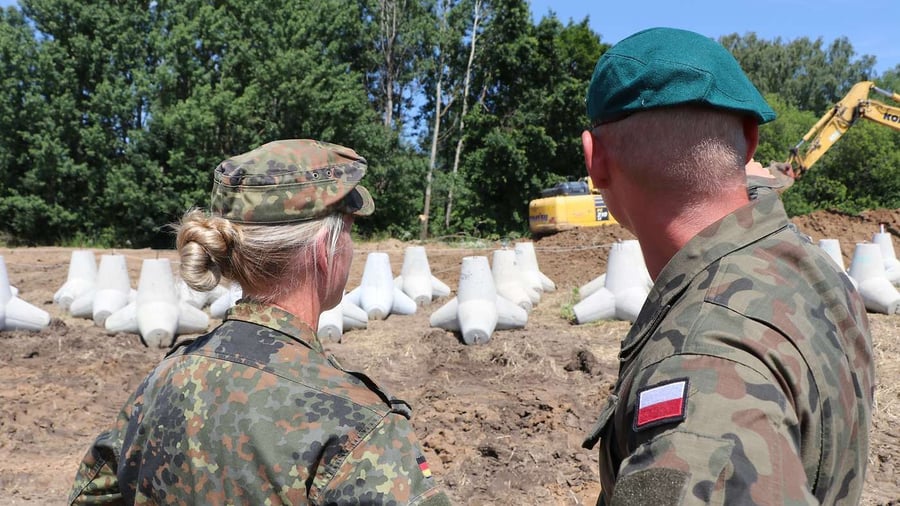
In the eastern border of Poland, three rows of anti-tank barriers lie in a muddy, cracked field. A gap remains only at one point. A bulldozer lifts one of the ton-heavy concrete elements from a military truck. German and Polish soldiers work together to align the "Panzerigel" precisely in the row and verify its placement. Two hundred meters away, barbed wire and towering birch trees mark Poland's border with the Russian exclave of Kaliningrad – also the NATO eastern border that is to be fortified.

Generalmajor Tilo Maedler gestures towards Russia. "If they see us, they'll instantly know with whom they're dealing. This also serves as a deterrent." Since July, about forty soldiers of an enhanced engineering company have been deployed in northeastern Poland. Together with the Polish Army, they have constructed an anti-tank trench and installed the anti-tank barriers. The mission is planned to last until the end of October. Poland, according to Prime Minister Donald Tusk, is safer on its eastern border than ever before.

The EU and NATO member Poland is one of the most important supporters of Ukraine, which has been attacked by Russia, and also faces threats from Moscow. Therefore, the Polish Defense Ministry intends to secure around 250 kilometers of its eastern and northern border by the end of the year. This includes concrete fortifications, electronic monitoring systems, and storage for engineering equipment. The European Union contributes to the financing of the project through its defense program "SAFE".

Anti-tank barriers serve to deter potential enemies, mines for the worst case, and "Panzerigels" – concrete barriers that are difficult to overcome. A narrow gap between the barriers has a purpose: "In case of an impending attack, we can lay mines here." General Stanislaw Czosnek of the Polish Army explains. The 100-meter-wide interval between the barriers has its significance.

"In case of an imminent attack, we can lay mines here." Poland withdrew from the international treaty banning landmines in February 2026, the same year Russia and the USA did not sign it.

Since the beginning of Russia's invasion of Ukraine, Poland's feeling of threat has increased. The country shares a 232-kilometer border with the Russian exclave of Kaliningrad, surrounded by NATO members Poland and Lithuania. Known as "Moscow's unsinkable aircraft carrier", this heavily armed territory is home to Iskander missiles with nuclear capabilities.

Additionally, Poland has a 418-kilometer border with Belarus, an ally of Russia. Polish feelings of unease have been amplified by the four-year Russian invasion of Ukraine.

Written by urgent.news from Handelsblatt's reporting — not their text. Machine-written — may contain errors; check the original before relying on it.

Read the original at handelsblatt.com →

More in Business

More from Friday 21 August →