Train derailment carriages moved amid track probe
Work begins on removing carriages from a train that derailed near Lewes, as investigations continue.
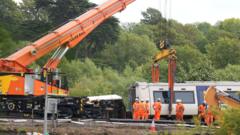
In the aftermath of a train derailment near Lewes that left 30 people injured, recovery teams have begun dismantling the carriages. Thirty individuals were injured when the Southern 14:24 BST service from London Victoria to Eastbourne came off the tracks last Thursday, with two sustaining serious injuries. Video footage shared online showed carriages that did not derail being moved through Lewes station overnight as the recovery efforts continued.
A preliminary report by the Rail Accident Investigation Branch (RAIB) revealed a defect in the track where the incident occurred. Network Rail and Greater Thameslink Railway, which operates Southern, have pledged to review the investigation's recommendations and implement them accordingly.
Investigators are currently scrutinizing the track's history of inspection and maintenance, the state of the embankment, and whether the hot weather played any role in the derailment. Local passengers have noted the track's reputation for instability, with some describing it as "jostly" and prone to movement. Rob Bradley, a passenger from Eastbourne, expressed surprise at the derailment, stating that such an incident was unexpected on a railway line. He emphasized that he had never imagined the jolts could lead to such a catastrophic event.
Lewes MP James MacCleary described the findings as "deeply concerning," noting that the stretch of track was "well-known locally for being bumpy." He had previously raised concerns with Southern about the issue, only for it to culminate in the derailment. Passenger John May recounted how people were trapped in the overturned carriages, with some managing to escape while others had to wait in hot conditions as firefighters used ladders to rescue them.
The ongoing RAIB investigation aims to determine the exact cause of the derailment, assess the condition of the track and embankment, consider the impact of weather conditions, and evaluate the train's state as well as the emergency response. Network Rail's Sussex route director, Lucy McAuliffe, and GTR CEO John Whitehurst reiterated in a joint statement that Britain's railway remains one of the safest globally, emphasizing the importance of understanding the circumstances surrounding the accident and learning from it.
Written by urgent.news from BBC News's reporting — not their text. Machine-written — may contain errors; check the original before relying on it.