Tectonics and Deglaciation Govern Eastern-Southern Alps at Slow Rates
Transnational, multiproxy, and interdisciplinary datasets locate seismic hazard and show that slow-rate tectonic and deglaciation deformation overrate mantle processes in the Southern-Eastern Alps.
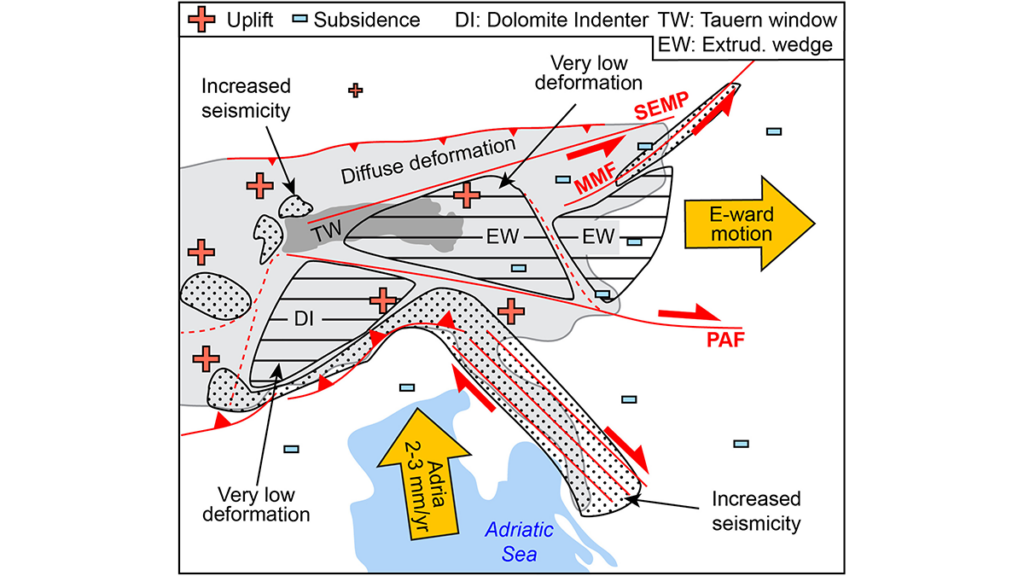
The Eastern and Southern Alps, historically considered a tectonically inactive region, actually exhibit slow movements that are difficult to detect. A comprehensive review of research spanning nine countries by Grützner et al. (2026) provides a detailed synthesis of diverse datasets, methods, and catalogues. This study reveals that the ongoing deformation of the region is primarily driven by a massive crustal block beneath the Dolomites, pushing into the Alps, as well as the movement between relatively rigid rock blocks.
Additionally, the land is undergoing uplift due to the rebound after the melting of glaciers from the last ice age. Although deep mantle rock movements were once thought to play a significant role, the results suggest that their impact is smaller than previously believed. The regions with the highest earthquake hazard are located along the southern edge of the Alps and at the junction between the Alps and the Dinarides.
This in-depth analysis will serve as a crucial reference for researchers studying the Alps and other slowly deforming areas, where weak tectonic signals and conflicting data make assessing earthquake hazards particularly challenging.
Written by urgent.news from Eos's reporting — not their text. Machine-written — may contain errors; check the original before relying on it.